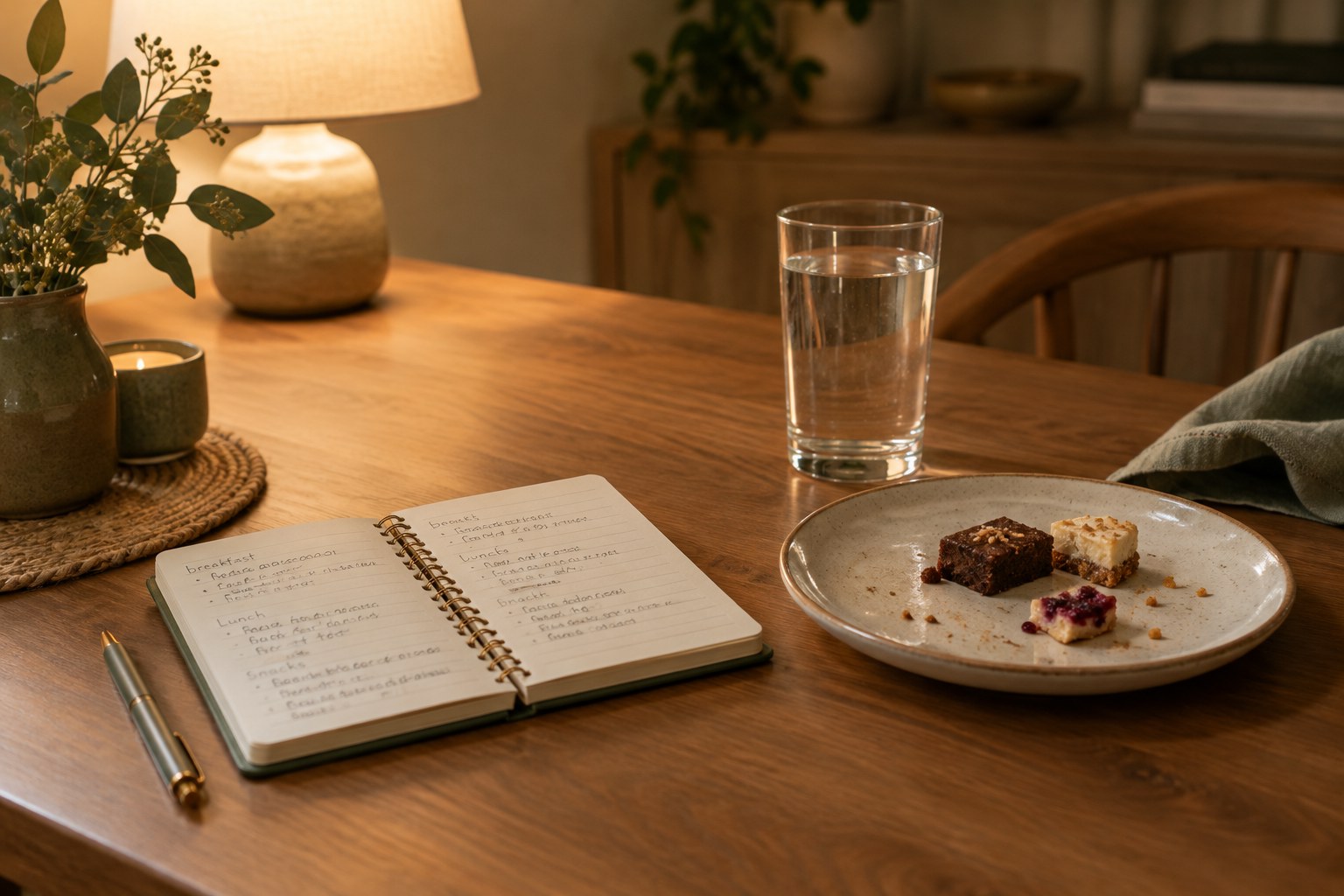
It is 9 p.m. Dinner was two hours ago. You sit down, pick up your phone and scroll for a while. Nothing holds your attention. You get up, open the fridge, look inside and close it. Ten minutes later, you are back.
Perhaps you are hungry. Perhaps dinner was small, or you had a long day and need a snack. But sometimes the fridge visit has less to do with hunger and more to do with a question you have not yet asked: What am I going to do with myself for the rest of the evening?
If food has become the easiest answer to that question, you are not alone. And you do not need to fill every quiet moment with a productive activity. You can learn to notice what is happening and give yourself more than one way to respond.
Why eating can make a boring evening feel different
Food offers something immediate: taste, texture, a small task and a change of pace. Walking to the kitchen gives you something to do. Choosing a snack gives you something to look forward to. Eating can make an otherwise flat evening more pleasant for a while.
There is nothing wrong with enjoying food. The difficulty comes when eating becomes your main way of dealing with unstructured time, especially if you regularly eat past comfortable fullness or find it gets in the way of a goal that matters to you.
Consider the thought: “There is nothing to do. I might as well eat.” It can feel like a statement of fact. Often, it is a quick conclusion made when you are tired and the alternatives are not immediately appealing.
Start by checking whether you need food
Before deciding that an urge is boredom, look at the day you have had. When did you last eat? Was the meal satisfying? Did you have enough food? Have you been unusually active?
If you are hungry, a meal or snack can be an appropriate response. You do not have to earn it by waiting. Hunger and boredom can also happen at the same time. You might need a snack and still benefit from thinking about how you want to spend your evening afterwards.
Try sitting down with the snack you choose, rather than treating it as something you should hide or finish as quickly as possible. Then carry on with your evening.
The thought that keeps the pattern going
Suppose you have eaten enough for now, yet you keep going back to the cupboard. You may notice a thought like: “I cannot stand being bored. I need something.”
I suggest questioning the word need. You may strongly want the pleasure or distraction food offers. That makes sense. But wanting the next few minutes to feel different does not mean you have only one option.
A response might sound like this:
“I would rather be entertained right now. This quiet evening is uncomfortable, but I can tolerate a few minutes of it. I can choose something else to do, and if I am hungry later, I can eat.”
The point is not to make boredom vanish immediately. It is to stop treating it as an instruction to go to the kitchen.
Make a short list before the difficult moment
When you are already restless, “find a hobby” is not much help. A specific list is more useful. Pick a few things that fit your actual life and are easy to begin:
- Read a few pages of a book you already enjoy.
- Play a short game or listen to part of a podcast.
- Send a message to someone you would like to hear from.
- Take a short walk, stretch, or have a shower.
- Make a cup of tea and sit somewhere other than the kitchen.
- Go to bed earlier if what you really need is rest.
None of these has to be as immediately exciting as your favourite snack. Choose one you are willing to try for five minutes. If it does not help, choose another. The goal is to give yourself a genuine alternative, not to force yourself through an evening you hate.
A practical plan for tonight
Write down a situation that happens often, along with the thought you tend to have. Then add one response and one action. For example:
Situation: I have finished dinner and I am watching television. I keep thinking about the biscuits in the kitchen.
Limiting thought: “The evening is boring. A few biscuits will give me something to do.”
Response: “They would taste good, and I can choose to have them. But if I am looking for something to do, I can also try another activity first. I do not have to decide on autopilot.”
Action: Check whether I am hungry. If I am, choose a snack and sit down with it. If I am not, play a game for five minutes, then check in again.
Put your plan somewhere you can actually see it. Adjust the words until they sound like something you would believe at 9 p.m., not just something that looks good on a page.
Pay attention to what worked
If you pause and choose another activity, give yourself credit for practising. Even if you still think about food. Even if the activity only holds your attention for a little while. You have done something different at a moment that normally runs on habit.
If you do eat when you were bored, you can still learn from it. What happened before you went to the kitchen? Were you genuinely hungry, tired, lonely or avoiding a task? Was your alternative too difficult to start? Use the answer to improve tomorrow’s plan.
During weight loss and maintenance, the aim is to build a way of living that can accommodate ordinary evenings as well as good days. That takes practice and adjustment. You do not have to solve every bored evening at once.
For another practical tool, read how to write response cards for emotional eating and weight maintenance.
More support
I’m Costin Liculescu, and at Mindset Over Menu I help people work on the thoughts and habits involved in weight loss and long-term maintenance. For a more structured approach to emotional eating, explore my Udemy course or join the Mindset Over Menu community. For individual coaching, contact me at +40 752 578 044.
My book How to Do Hard Things: The Discomfort Trap explores how to handle discomfort when you are working towards something that matters to you. It is also available in audio on Spotify and ElevenReader.