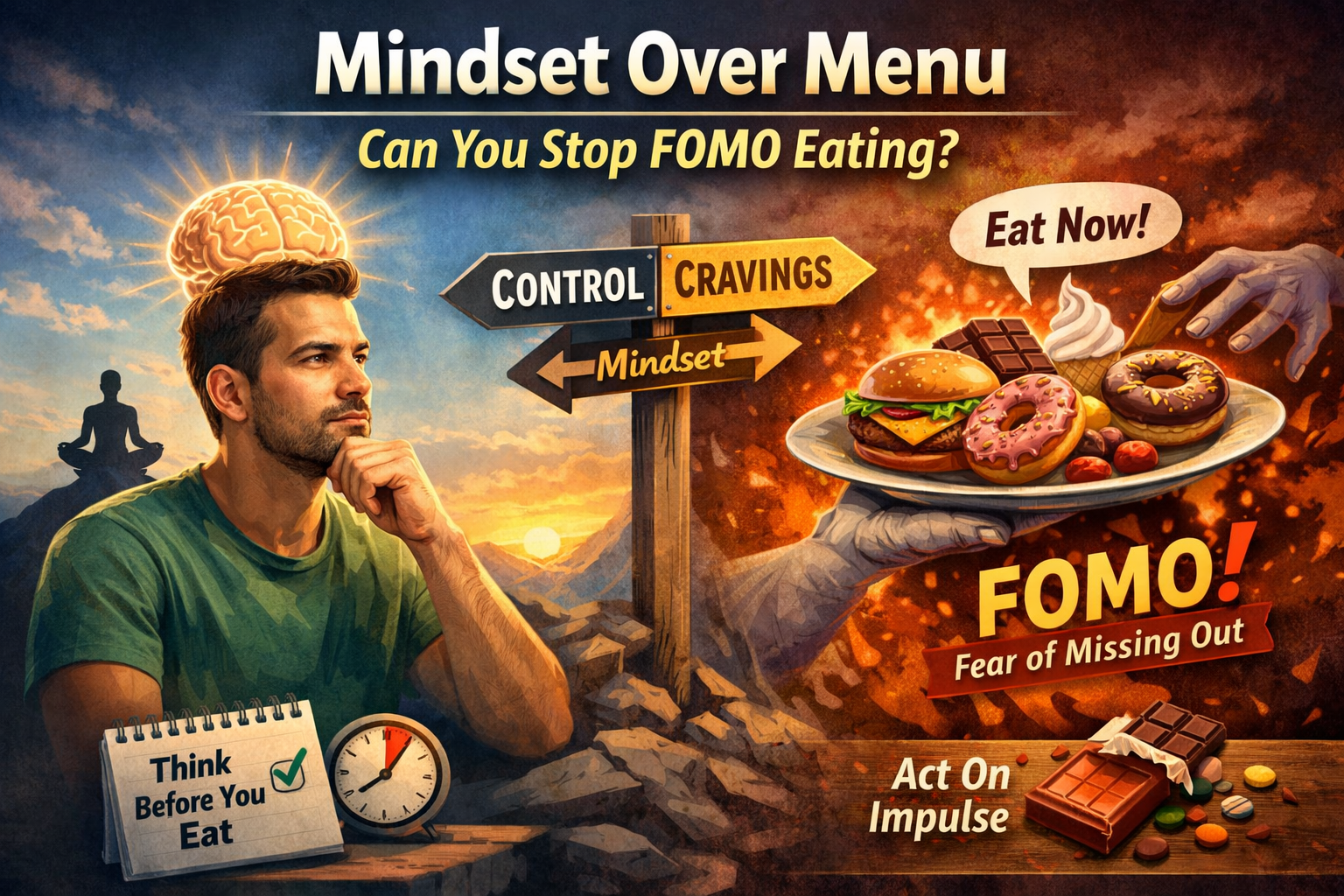
In my experience, one of the sabotaging behaviors I’ve heard people struggling with is this: the moment someone has a craving, they instantly go eat — like cravings are a remote control and you’re a robot.
Nope.
That behavior is exactly what we target in this article, because this is where it usually breaks: a craving shows up, and the mind turns it into a command.
But cravings are not commands. They’re sensations + thoughts + habits. And you can learn to respond differently.
—
First: cravings are normal (and deeply human)
Most of us have been in that situation where—even after eating—we still want to eat something else. Some people want sweet foods, others want salty foods, others want fatty foods… but the theme is the same: we crave.
And that’s normal.
Humans wouldn’t eat if we had zero cravings, and our bodies wouldn’t survive without appetite and food-seeking drives. From an evolutionary standpoint, craving and appetite are deeply rooted in our biology. Your brain is designed to notice food, want food, and feel rewarded by food.
So having cravings doesn’t mean you’re broken. It doesn’t mean you’re weak. It doesn’t mean you’re “bad at discipline.”
It means you’re human.
Now here’s the key:
Just because cravings are normal doesn’t mean you must obey them.
A strong tendency isn’t a law. A desire – even a powerful one – is not a necessity.
—
The real issue: when the craving becomes “I must”
A craving becomes a problem when your mind adds this belief:
“I want it, therefore I must have it. Right now.”
That’s the “FOMO craving” logic:
- “If I don’t eat it now, I’m missing out.”
- “If I don’t satisfy this craving, something important disappears.”
- “I won’t feel okay unless I do it.”
- And sometimes there’s a second trap waiting right behind it:
“If I ate one piece, I already ruined it… so I might as well keep going.”
The ABC model: what’s actually happening?
A — Activating event
You’ve eaten already. Example: you had a bowl of cereal with milk.
Then you suddenly want something sweet.
And you remember: There’s chocolate in the house.
B — Belief (the sabotaging thought)
Here’s the belief running quietly in the background:
“I have a craving, so I must satisfy it now. If I don’t, I’m missing out. I won’t feel okay unless I do.”
C — Consequences (what happens next)
Behaviorally: you eat impulsively… and often it turns into the domino effect:
one thing leads to another, and suddenly you’re way over your planned calories.
Disputation (D): the moment you take your power back
This is the part most people skip.
They try to “want it less”.
But the real target is the must (you transform the want into a command).
So let’s dispute it:
Where is it written that you must eat because you crave something?
Is there some law of nature that grabs your hand, points it toward the chocolate, breaks off a piece, chews it for you, and forces you to swallow?
No.
Cravings can feel urgent, but they don’t control your behavior. You still choose the action.
And yes – this matters: You can acknowledge the craving without obeying it.
“I can tolerate it” (and why it’s worth it)
This is where people assume you’re saying, “Just be strong.” I’m not.
I’m saying something much more practical and much more human:
I can tolerate this craving.
Not because it’s pleasant. Not because it’s easy.
But because tolerating discomfort is something I’m capable of—and I won’t fall apart if I do it.
Let me say it clearly:
- I won’t disintegrate if I feel a strong craving and don’t act on it.
It will feel uncomfortable, yes. I will feel it, yes. I’m not denying it or sweeping it under the rug.
But discomfort is not danger. It’s just discomfort. - And here’s why it’s worth tolerating—why it’s not just “discipline” for discipline’s sake:
Because every time I tolerate a craving, my self-control grows.
My food control grows.
My health grows.
I’m doing it for my desire to be healthy and strong in the world.
I’m doing it because I want to live longer, but also to live better—healthy for longer, not just existing for longer.
I’m doing it because I want to enjoy life more: the things I love, the people I love, the things I want to do.
And because I genuinely believe this: I deserve that. I deserve to live more. I deserve to live better. Not because I “earned it” through perfect behavior. Not because other people approve of me. But because I’m a human being—and my value as a person doesn’t depend on what I ate today.
So yes, the craving can be strong. I can admit that. I can even say, “This is hard, or very hard.”
And at the same time I can say:
I’m still the one in charge.
I’m determined. And I’m going to tolerate the uncomfortable feeling of craving without eating.
And remember: I’m not “banning” the food forever.
I can say:
“Not now.”
“Not impulsively.”
“But I can include it later – in my plan.”
The chocolate (or what you’re craving) doesn’t disappear from the universe. I’m not losing it forever. I’m just choosing timing and control.
New healthy belief (E): cravings are allowed, commands are preferably not.
Here’s the belief you could practice:
“I have a craving, and it’s normal. But cravings aren’t commands.”
“I’m not missing out—food still exists later.”
“I can tolerate this discomfort. It’s unpleasant, not dangerous.”
“I choose what I do next.”
“Having cravings doesn’t mean I’m weak. It means I’m human – no value judgement.”
Practical plan:
Read the new healthy belief above
Write on an index card/telephone/ your preferred device a card with your new basic attitude and read it firmly when you feel the craving:
“Craving isn’t a command. I’m not missing out, I’m proving control to myself!”
Set a 10-minute timer
No negotiating inside the craving wave.
Timer. Water/tea. Breathe.
Decide: include it, but in the plan
Pick one option:
“I’ll include it tomorrow inside my calories.”
“I’ll include it at my next meal (budgeted).”
“I’ll include it today, but portioned: 2 squares—then done.”
This breaks the FOMO spell because you’re telling your brain: “We’re not banning it. We’re choosing it.”
If you already ate some—stop the spiral
Say: “Okay, I ate a piece. That doesn’t mean the day is ruined. The next decision matters most.”
That sentence prevents the “what-the-hell effect” (the spiral where one slip becomes a full binge).
Bonus strategies (make autopilot harder)
If cravings are a frequent trap for you, use simple environmental tools:
Add friction: put trigger foods in an annoying spot (high shelf, back of pantry, inside a box).
Pre-portion: portion chocolate (or other treat that you desire) into small bags/containers ahead of time.
Move your body for 5 minutes: quick walk around the house, shower, anything that breaks the loop physically.
Check meal satiety: cravings can be louder when meals are low in protein/fiber. Small tweaks can reduce the noise. Eat enough protein and/or fiber when you’re having your meals.
The goal isn’t zero cravings.
The goal isn’t to become a person who never wants chocolate (or any other treat).
The goal is to stop living by this rule:
“Craving = immediate action.”
Once you break that link a few times, something shifts. You start feeling real control – not because cravings disappear, but because you finally trust yourself to handle them.
And that’s how consistency is built: not by perfect days, but by having a healthy attitude and a repeatable plan for the moments when your brain yells: “NOW.”
As always, you can find more help in my book: