
TL;DR:
- Community support significantly enhances long-term weight loss success.
- Support networks reduce emotional eating by modulating neural pathways and boosting self-efficacy.
- The effectiveness of community varies; supportive, well-structured groups and positive relationships are key.
Most people trying to lose weight blame themselves when it doesn’t stick. “I just need more willpower,” they say. But here’s what the research actually shows: community-based interventions significantly influence weight loss outcomes, often more than individual effort alone. That’s not a small footnote. That’s a fundamental shift in how we should think about sustainable weight loss. This article breaks down why community matters, what kinds of support actually work, how group involvement helps with emotional eating, and where the limits are. Because knowing all of this? That’s where real, lasting change begins.
Table of Contents
- Why community support matters in weight loss
- Types of community support and how they work
- How community buffers emotional eating and prevents relapse
- Limits and nuances: When community works and when it doesn’t
- A fresh perspective: Community isn’t magic, here’s what actually matters
- Ready to build your support system? Find resources and guidance
- Frequently asked questions
Key Takeaways
| Point | Details |
|---|---|
| Social support is powerful | Supportive communities improve weight loss and healthy habit adoption far beyond going it alone. |
| Multiple support types matter | Family, online peer groups, and faith-based supports all play unique roles in driving results and emotional resilience. |
| Beware negative influences | Negative or unsupportive environments can sabotage progress, so it’s critical to choose your support system intentionally. |
| Sustainable change needs both | Community is a catalyst, but pairing it with individual mindset and behavioral strategies leads to lasting success. |
Why community support matters in weight loss
Willpower is real. But it’s also exhausting. And it runs out.
What doesn’t run out quite as fast? The feeling that someone else is rooting for you. That’s not just feel-good advice. That’s neuroscience.
Research shows that social support modulates neural pathways to reduce food cravings and emotional eating. In plain terms: when you feel supported, your brain literally responds differently to the urge to eat a whole bag of chips at 10 p.m. The reward system quiets down a little. The prefrontal cortex, the part that helps you make thoughtful choices, gets more airtime.
And it goes deeper than brain chemistry.
When people around you model healthy behaviors, you start to believe you can do it too. That belief is called self-efficacy, and it’s one of the strongest predictors of long-term behavior change. Seeing your friend choose the salad, watching your group celebrate a small win, hearing someone say “I struggled this week too” — all of that rewires what feels possible for you.
Faith-based and family-supported interventions have been shown to increase fruit and vegetable intake and support lasting behavioral change. In group settings, up to 62% of the improvement in eating habits is attributed directly to social support. That number is hard to ignore.
Here’s a quick look at how community support compares to solo effort across key weight loss factors:
| Factor | Solo effort | With community support |
|---|---|---|
| Self-efficacy | Moderate | High |
| Dietary adherence | Variable | More consistent |
| Emotional eating frequency | Higher | Reduced |
| Long-term maintenance | Challenging | More achievable |
Some of the key ways community drives change:
- Accountability keeps you honest without being harsh
- Shared struggles normalize the hard days so you don’t spiral
- Positive modeling shows you what’s actually possible
- Encouragement fuels motivation when yours runs low
- Celebration of small wins builds momentum
“You don’t have to do this alone. And honestly, you probably shouldn’t.”
Pro Tip: When building your support circle, pay attention to how people make you feel after conversations. Energized and motivated? Keep them close. Judged or discouraged? That’s a boundary worth setting. Explore weight loss coaching models and behavioral weight management approaches to find what fits your life.
Types of community support and how they work
Not all community looks the same. And that’s actually great news, because it means there’s something that can work for almost everyone.
Let’s break down the main forms:
-
Family support shapes your daily environment. When your household buys different groceries, cooks different meals, or takes evening walks together, the healthy choice becomes the easy choice. Family involvement makes the change feel less like a solo mission and more like a shared direction.
-
Peer groups and coaching create structured accountability. Peer coaching in primary care led to higher percentage weight loss at 12 months compared to standard care. Having someone who’s been through it, not just a clinician talking theory, makes a real difference.
-
Digital and virtual communities expand access dramatically. Online forums, group apps, and virtual programs can match or even rival in-person results, especially for people who can’t easily access local programs due to location, schedule, or mobility.
-
Structured group programs offer a blend of education, accountability, and emotional support in a consistent format.
Here’s how these types compare across a few key dimensions:
| Support type | Accessibility | Accountability level | Emotional connection |
|---|---|---|---|
| Family | High | Moderate | High |
| Peer/coaching | Moderate | High | High |
| Digital/virtual | Very high | Moderate | Moderate |
| Structured groups | Moderate | High | Moderate to high |
One standout example: the REWIND virtual program achieved 16% weight loss at 6 months and maintained 14% at 18 months. Those are numbers that rival clinical interventions. All done remotely.
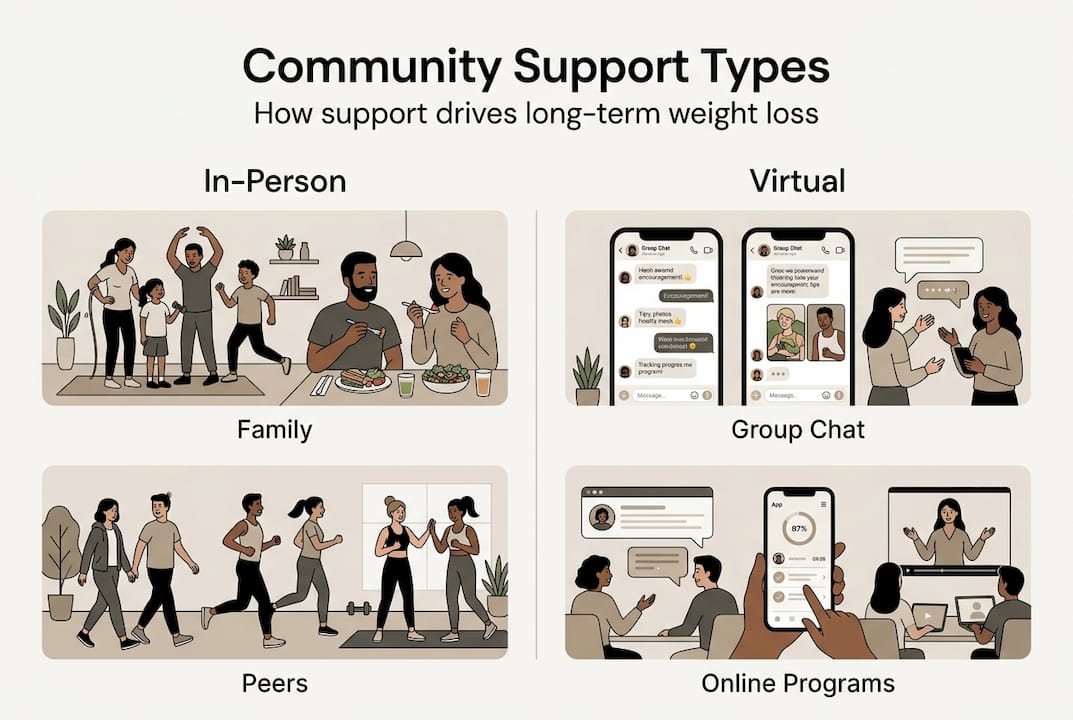
The takeaway? Community doesn’t have to mean showing up to a meeting every Tuesday night. It can be a group chat, a coaching call, or a family dinner where everyone’s trying something new together.
If you’ve hit a rough patch before, understanding overcoming weight loss setbacks and the role of accountability can help you choose the right type of support before you need it most.
How community buffers emotional eating and prevents relapse
Emotional eating doesn’t show up politely. It shows up when you’re stressed, lonely, bored, or frustrated, and it brings cravings like an uninvited guest who brought friends.

This is where community does something really powerful.
Social support buffers the connection between stress, emotional eating, and unhealthy choices. When you have someone to talk to, or a group that gets it, the emotional charge behind a craving loses some of its grip. You’re not white-knuckling it alone anymore.
Common emotional eating triggers and how community helps:
- Stress at work → A buddy check-in call shifts your focus before the kitchen raid happens
- Loneliness in the evening → A group chat or scheduled accountability message fills the gap
- Feeling like a failure after a slip → Community normalizes it: “Me too. Here’s what I did next.”
- Boredom → Distraction strategies shared by the group give you real options, not just “don’t eat”
- Celebration eating → The group helps you celebrate without food being the only reward
Small wins celebrated by others become anchors. They remind your brain that progress is real, even when the scale doesn’t move.
“Sharing your struggle out loud is not weakness. It’s actually one of the most effective tools you have.”
Pro Tip: Don’t wait until you’re in crisis mode to reach out to your support group. Share early, share often. Research shows that verbalizing your challenges activates brain areas involved in self-regulation, which helps you make better choices in the moment.
But here’s the flip side. Negative social support from family or peers, think sabotage, dismissiveness, or constant comparison, increases stress and actively hinders weight loss. Not every person in your life is a safe support. Know the difference. And check out strategies to maintain progress for tools that work alongside your community, not instead of it.
Limits and nuances: When community works and when it doesn’t
Okay, let’s be honest here. Community isn’t a magic switch.
Joining a Facebook group or signing up for a wellness challenge doesn’t guarantee anything. The research is clear that group-based interventions are only slightly more effective than solo approaches for functional health outcomes, and negative social dynamics can actually make things worse.
Who tends to benefit most from community support:
- Women, who often report stronger emotional benefits from group settings
- Younger adults who are more comfortable with digital and peer-based formats
- Individuals from minority communities when the group is culturally tailored to their background and values
- People who are already somewhat motivated but need external accountability to stay consistent
When community works best:
- When the group culture is supportive, not competitive or shame-based
- When participation is consistent, not just during the “honeymoon” phase
- When it’s paired with individual mindset work, not used as a replacement for it
Warning signs of harmful group dynamics:
- Constant comparison or ranking of members by weight lost
- Shaming language, even if it’s framed as “tough love”
- Social media communities that trigger anxiety or inadequacy
- Leaders who push extreme methods or dismiss individual struggles
“The right community lifts you. The wrong one quietly drains you. Learn to tell the difference before you’re already depleted.”
Long-term weight maintenance is genuinely hard, and relapse is common. Community helps, but it’s not a substitute for the internal work. Pair it with mindset shifts for sustainable results and developing sustainable habits to build something that actually lasts.
A fresh perspective: Community isn’t magic, here’s what actually matters
I’ve seen people join every group imaginable and still not move the needle. And I’ve seen people in a single coaching relationship completely transform their relationship with food. The difference wasn’t the size of their support network. It was whether the support matched what they actually needed.
Here’s the honest truth: community gives you tools and mirrors. It shows you what’s possible and holds you accountable. But the real transformation happens inside. It happens when you shift the story you tell yourself about who you are and what you’re capable of.
No group can do that for you. What a group can do is create the conditions where that shift becomes more likely.
Choose environments that feel safe, not just popular. Set boundaries early, before someone’s “helpful” comment becomes a source of shame. And evaluate every group with one question: does this make me more or less likely to show up for myself tomorrow?
The work on self-talk and group influence matters here. Because even in the best community, you’re still the one having the conversation in your own head.
Pro Tip: Before joining any group, spend five minutes writing down your core values around health. Then ask yourself if the group reflects those values. If the answer is no, keep looking.
Ready to build your support system? Find resources and guidance
You now know the science. Community support is powerful, nuanced, and worth building intentionally. But knowing it and doing it are two different things.
At Mindset Over Menu, we help you build both the internal foundation and the external support structure you need for lasting change. Whether you’re exploring personalized coaching and support or looking to understand how to unlock lasting change through accountability, we meet you where you are. And if you’re focused on the long game, our resources on how to maintain weight loss will give you a practical roadmap. You don’t have to figure this out alone.
Frequently asked questions
How does community support reduce emotional eating?
Social support modulates neural reward pathways and buffers emotional triggers, making it easier to pause before reacting to a craving with food. It essentially gives your brain a different, healthier outlet for stress.
Are group-based weight loss programs more effective than going solo?
Group-based interventions show small advantages in functional and emotional outcomes, but overall weight loss results are often similar to solo efforts. The real edge is in consistency and emotional resilience over time.
What types of community support have the biggest impact?
Faith-based, family, peer, and virtual group supports drive the strongest sustained results, and virtual programs like REWIND show that remote community can be just as powerful as in-person when structured well.
Can negative community support harm my progress?
Absolutely. Negative support from family and peers increases stress and actively undermines healthy behavior change, making it critical to recognize and set boundaries with unsupportive relationships.
Recommended
- How to maintain weight loss: mindset strategies 2026
- Real-life weight loss guide: 5-10% success in 2026
- Daily habits for weight management: sustainable strategies
- Accountability in weight loss: unlock lasting change