
TL;DR:
- Behavioral weight management focuses on habits, mindset, activity, and realistic diet adjustments.
- Knowing your change stage and using models like MI and CBT can enhance progress.
- Consistent self-monitoring, emotional regulation, and small adjustments support long-term success.
Most people don’t fail at weight loss because they lack willpower. They fail because nobody taught them how their behavior, emotions, and habits are running the show behind the scenes. You’ve probably tried the diets. Maybe more than once. And maybe the weight came back, along with a side of guilt and confusion. Behavioral weight management combines diet, physical activity, and behavioral strategies like self-monitoring, goal setting, and counseling to create lasting results. This guide walks you through exactly how it works, how to get started, and how to keep going when things get hard.
Table of Contents
- What is behavioral weight management?
- Preparing for change: Foundational models and readiness
- Executing sustainable strategies: Practical steps and tools
- Troubleshooting and overcoming common barriers
- Our take: What most weight loss guides miss about sustainable change
- Ready for more support? Explore coaching and resources
- Frequently asked questions
Key Takeaways
| Point | Details |
|---|---|
| Start with behavioral basics | Successful weight loss combines diet, exercise, and behavioral strategies like self-monitoring and regular feedback. |
| Tailor interventions to readiness | Assess your stage and use models like Motivational Interviewing and CBT for emotional eating. |
| Consistency trumps perfection | Regular activity, monitoring, and emotion regulation matter more than flawless adherence. |
| Plan for setbacks | Expect occasional obstacles and have a strategy to regroup, adapt, and maintain momentum. |
| Leverage support and accountability | Coaching, social support, and mindset resources dramatically improve long-term outcomes. |
What is behavioral weight management?
Let’s clear something up right away. Behavioral weight management isn’t just another diet plan with a fancier name. It’s a structured, science-backed approach that treats weight loss as a behavior change problem, not a food problem.
That’s a big shift. And it changes everything.
At its core, behavioral weight management combines three things working together:
- Diet adjustments that are realistic and sustainable
- Physical activity that fits your actual life
- Behavioral techniques like self-monitoring, goal setting, problem solving, and counseling
Think of it like a three-legged stool. Remove any one leg and the whole thing tips over. That’s why diets alone rarely work long term. They only address one leg.
Here’s a quick look at how behavioral weight management compares to traditional dieting:
| Approach | Focus | Long-term success |
|---|---|---|
| Traditional diet | Food restriction | Often low |
| Exercise-only plan | Calorie burn | Moderate |
| Behavioral weight management | Habits, mindset, activity, food | Significantly higher |
The behavioral tools are what make the real difference. Self-monitoring means tracking what you eat, when you eat, and how you feel when you eat. Goal setting means creating specific, realistic targets. Counseling, whether with a coach or therapist, helps you unpack the emotional patterns driving your choices.
And the results? Programs with more than 14 counseling sessions over six months achieve 5 to 10% weight loss on average. That might not sound dramatic, but for most people it’s the difference between managing health conditions and not.
If you’re building daily habits for weight management, behavioral strategies give those habits a real foundation to stand on.
One important note: be cautious of programs promising rapid loss. They rarely address the behavioral patterns underneath, which means the weight usually comes back. Weight management treatment guidelines consistently emphasize gradual, sustainable progress over quick fixes.
Preparing for change: Foundational models and readiness
Knowing what behavioral weight management is matters. But knowing where you are in the change process matters just as much.
This is where behavioral models come in. They’re not just academic theory. They’re practical maps that help you figure out your starting point and what kind of support you actually need.
The Transtheoretical Model (also called the stages of change) breaks behavior change into five stages:
- Precontemplation – Not yet thinking about change
- Contemplation – Aware of the problem, but not ready to act
- Preparation – Getting ready, making small moves
- Action – Actively changing behavior
- Maintenance – Sustaining the new behavior long term
Knowing your stage helps you stop blaming yourself for not being further along. If you’re in contemplation, you don’t need a strict meal plan yet. You need to explore your ambivalence.
Motivational Interviewing (MI) is a counseling style that does exactly that. It meets you where you are without judgment and helps you find your own reasons to change. MI results in 1.47 kg greater weight loss compared to controls. That’s not just a statistic. That’s what happens when someone feels heard instead of lectured.
Cognitive Behavioral Therapy (CBT) goes a layer deeper. It targets the thoughts and beliefs driving your eating patterns. The story you tell yourself after a bad day at work, the automatic reach for comfort food, the all-or-nothing thinking after one slip. CBT helps you rewrite those scripts.
For emotional eaters specifically, emotion regulation research shows that adding emotion regulation skills, self-monitoring, and social support significantly improves outcomes. Because emotional eating isn’t a character flaw. It’s a coping strategy that needs a better replacement.

Exploring mindset shifts for weight loss alongside these models can accelerate your readiness to act. And pairing that with habits and mindset for long-term success gives you both the map and the vehicle.
Pro Tip: Start a simple daily log, not just of food, but of your mood before and after eating. Even two weeks of this data will show you patterns you never noticed before.
Executing sustainable strategies: Practical steps and tools
Okay. You understand the approach. You know your stage. Now let’s talk about what to actually do.
Here are the core strategies that make behavioral weight management work in real life:
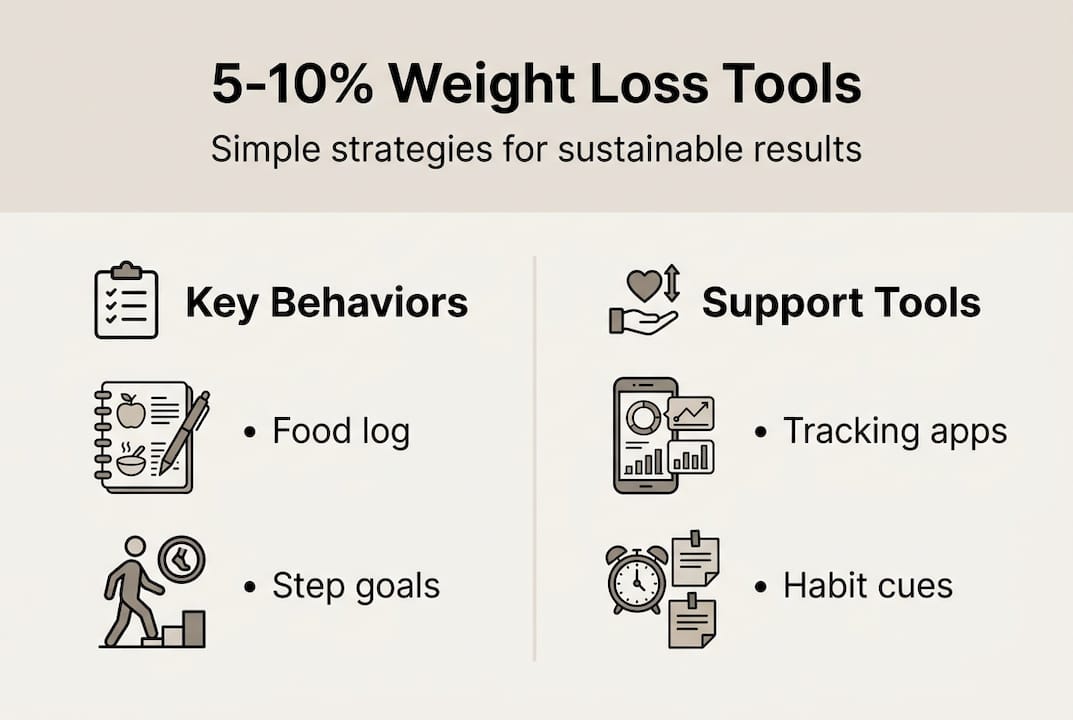
- Set a realistic goal. Aim for 5 to 10% of your body weight over six months. Not 30 pounds by summer. A realistic target keeps motivation alive and prevents the crash-and-burn cycle.
- Track everything, not just food. Log what you eat, when you move, and what emotions showed up. Patterns are your best teacher.
- Build physical activity gradually. Maintaining weight loss requires 300 minutes of physical activity per week. Start where you are and build up. Walking counts.
- Add resistance training. Resistance training preserves muscle mass during weight loss and supports metabolic health. This matters more than most people realize, especially as the scale moves.
- Practice emotion regulation. When stress or boredom hits, have a go-to strategy ready. A short walk, a breathing exercise, calling a friend. Something that isn’t food.
- Plan for setbacks. Not if they happen. When. Decide in advance how you’ll respond when a hard week derails your routine.
Here’s a quick reference for common emotional triggers and practical responses:
- Stress eating → 5-minute walk or box breathing before opening the fridge
- Boredom eating → Keep a short list of non-food activities nearby
- Celebration eating → Enjoy intentionally, then return to your plan without guilt
- Fatigue eating → Prioritize sleep as a weight loss tool, not an afterthought
Building identity change for weight loss into your approach means you start seeing yourself as someone who is healthy, not someone who is trying to be. That shift is subtle but powerful. Check out healthy habits for lasting success for more on building those habits into your daily rhythm.
Also, review the eating and physical activity guidelines to make sure your plan aligns with evidence-based targets.
Pro Tip: Consistency beats perfection every single time. One good week followed by a rough week is still progress. The goal is the average, not the highlight reel.
Troubleshooting and overcoming common barriers
Even when you’re doing everything right, barriers show up. That’s not failure. That’s just how change works.
Here are the most common ones and how to handle them:
- Emotional eating flare-ups. Life gets hard and old habits resurface. Emotional eating interventions reduce weight by 4.09 kg on average, but they also acknowledge that setbacks happen. The focus is on regrouping, not on being perfect.
- Motivational dips. You’ll have weeks where you just don’t care. That’s normal. Revisit your original reasons for starting. Write them down somewhere visible.
- Plateaus. The scale stops moving and your brain goes: “What’s the point?” Plateaus are a sign your body is adapting, not that you’ve failed. Tweak your activity level or review your tracking for patterns you might have missed.
- Social pressure. Family dinners, office snacks, social events. These feel like minefields. Having a plan in advance, even a simple one, makes them manageable.
- All-or-nothing thinking. One bad meal becomes “I’ve ruined everything.” This thinking pattern is one of the biggest barriers to long-term success. Catch it early.
“Setbacks are common. Regrouping and adapting is what matters most.”
The tools that help most here are pattern tracking, emotion regulation, and social support. You don’t have to white-knuckle through barriers alone. Understanding why relapse happens in weight loss can reframe setbacks as data instead of defeat. And building self-awareness for better results means you catch the early warning signs before a slip becomes a spiral.
Small adjustments, made consistently, add up to big shifts over time. That’s not motivational fluff. That’s just how behavior change actually works.
Our take: What most weight loss guides miss about sustainable change
Here’s something most guides won’t say out loud: the reason so many people keep cycling through diets isn’t laziness or lack of discipline. It’s that the tools they’re given don’t match the actual problem.
Emotional eating isn’t solved by a meal plan. A plateau isn’t fixed by cutting more calories. Motivation doesn’t return just because someone tells you to “stay consistent.”
What actually works is addressing the why behind the behavior. And that requires a personalized approach, not a one-size-fits-all program.
I’ve seen it over and over. The people who make lasting change aren’t the ones who follow the strictest plan. They’re the ones who learn to notice their patterns, respond to setbacks with curiosity instead of shame, and make small adjustments without abandoning the whole thing.
Building sustainable daily habits and practicing mindset shifts for lasting change aren’t extras. They’re the actual work. Everything else is just the surface.
Self-compassion isn’t soft. It’s strategic. And it’s the ingredient most weight loss guides leave out entirely.
Ready for more support? Explore coaching and resources
If this resonated with you, you don’t have to figure out the next steps alone.

At Mindset Over Menu, we offer personalized weight loss coaching built around behavioral strategies, mindset work, and real-life application. No rigid meal plans. No shame. Just practical, science-backed support tailored to where you actually are. If you’re navigating a plateau or recovering from a setback, our guide on overcoming setbacks is a great next read. And if you’re thinking about the long game, explore our strategies for maintaining weight loss for the mindset tools that keep results lasting.
Frequently asked questions
How many counseling sessions are needed for effective weight loss?
Programs with more than 14 sessions over six months are consistently linked to 5 to 10% weight loss. More touchpoints mean more accountability and faster pattern recognition.
What role does emotional eating play in weight management?
Emotional eating can quietly undermine even the best plan. Emotion regulation interventions combined with self-monitoring and social support significantly improve both weight outcomes and eating behavior scores.
Are digital weight loss programs as effective as in-person ones?
Intensive digital programs can match in-person results when they include frequent contact, structured support, and behavioral coaching elements.
What’s the recommended physical activity for maintaining weight loss?
Sustaining your results long term requires at least 300 minutes of moderate physical activity each week, combined with continued self-monitoring and a balanced eating approach.
How should setbacks and plateaus be handled?
Treat them as information, not failure. Regrouping after setbacks and adjusting your strategy, rather than abandoning it, is what separates people who maintain their progress from those who don’t.
Recommended
- Daily habits for weight management: sustainable strategies
- How to maintain weight loss: mindset strategies 2026
- Real-life weight loss guide: 5-10% success in 2026
- Self-awareness for weight loss: 5% better results