
Most people who struggle with their weight aren’t missing information. They know vegetables are better than chips. They’ve read the diet books. They’ve tried the plans. And yet, the weight comes back. Again. The real gap isn’t knowledge. It’s the unaddressed mindset, the emotional patterns, and the habits running quietly in the background. Weight loss coaching steps into that gap. It works not by handing you a meal plan, but by helping you understand why you eat the way you do, and then building the mental and behavioral foundation for change that actually sticks.
Table of Contents
- What is weight loss coaching?
- Core techniques: How weight loss coaching works
- Benefits for emotional eaters and long-term changers
- Limitations, edge cases, and what to expect
- Our perspective: Why mindset matters more than meal plans
- Start your sustainable weight loss journey
- Frequently asked questions
Key Takeaways
| Point | Details |
|---|---|
| Mindset over meal plans | Long-term weight loss succeeds by changing thinking patterns, not just meals. |
| Behavior-based tools work | Techniques like MI, CBT, and habit stacking help tackle triggers and build new habits. |
| Personalization is essential | The best coaching adapts to your emotional needs, life stage, and relapse risk. |
| Continuous support required | Ongoing coaching prevents weight regain and supports lasting change. |
What is weight loss coaching?
Weight loss coaching is a collaborative process. You and a coach work together to identify the beliefs, habits, and emotional patterns that are keeping you stuck. It’s not about being told what to eat. It’s about understanding how you think, feel, and respond to food, stress, and life in general.
This is where it diverges sharply from traditional diet plans. A diet plan is prescriptive. It says: eat this, not that. A coach asks: what’s driving the choices you’re already making? That’s a fundamentally different starting point.
The work is psychological, behavioral, and accountability-based. Core methodologies include motivational interviewing (MI), cognitive-behavioral therapy (CBT), and other behavioral techniques that help you rewire the thought patterns behind your eating. It’s not fluffy. It’s structured, science-backed, and deeply personal.
Coaching also embraces what’s called a holistic weight loss approach, meaning it looks at the whole person, not just the number on the scale. Sleep, stress, self-talk, social environment, all of it matters.
Here’s a quick comparison to help clarify the differences:
| Approach | Focus | Method | Best for |
|---|---|---|---|
| Diet plan | Food intake | Prescriptive rules | Short-term structure |
| Medical intervention | Clinical weight management | Medication, surgery | Severe obesity |
| Weight loss coaching | Mindset and behavior | Collaborative, adaptive | Long-term change |
Coaching is especially powerful for people who:
- Have tried multiple diets without lasting success
- Struggle with emotional eating or stress eating
- Know what to do but can’t seem to follow through
- Want to change their relationship with food, not just restrict it
- Are looking for accountability and personalized support
In short, coaching isn’t a shortcut. It’s the deeper work. And for most people, it’s the work that was always missing.
Core techniques: How weight loss coaching works
Good coaching isn’t guesswork. It draws on proven psychological and behavioral tools that have been studied and refined over decades. Methodologies include motivational interviewing, cognitive-behavioral therapy, goal setting, habit stacking, and regular accountability check-ins, all tailored to where you are right now.
Let’s break down what these actually look like in practice:
- Motivational interviewing (MI): This is a conversational technique where the coach helps you explore your own reasons for change. Instead of being told what to do, you discover your own motivation. The brain responds much better to internal drive than external pressure.
- Cognitive-behavioral therapy (CBT) techniques: CBT helps you identify and challenge the thought patterns that lead to self-sabotage. Things like “I already messed up today, so I might as well eat everything” get examined and replaced with more realistic thinking.
- Habit stacking: This is the practice of attaching a new healthy behavior to an existing habit. Want to drink more water? Stack it onto your morning coffee routine. Small and sticky beats big and overwhelming every time.
- SMART goal setting: Goals need to be Specific, Measurable, Achievable, Relevant, and Time-bound. “Eat better” is not a goal. “Cook dinner at home four nights this week” is.
- Accountability check-ins: Regular sessions keep you honest and help you course-correct before small slips become full derailments.
Coaches also use what’s called the transtheoretical model, which basically means meeting you where you are. Someone who’s just starting to think about change needs different support than someone who’s already taking action. Good coaching adapts.
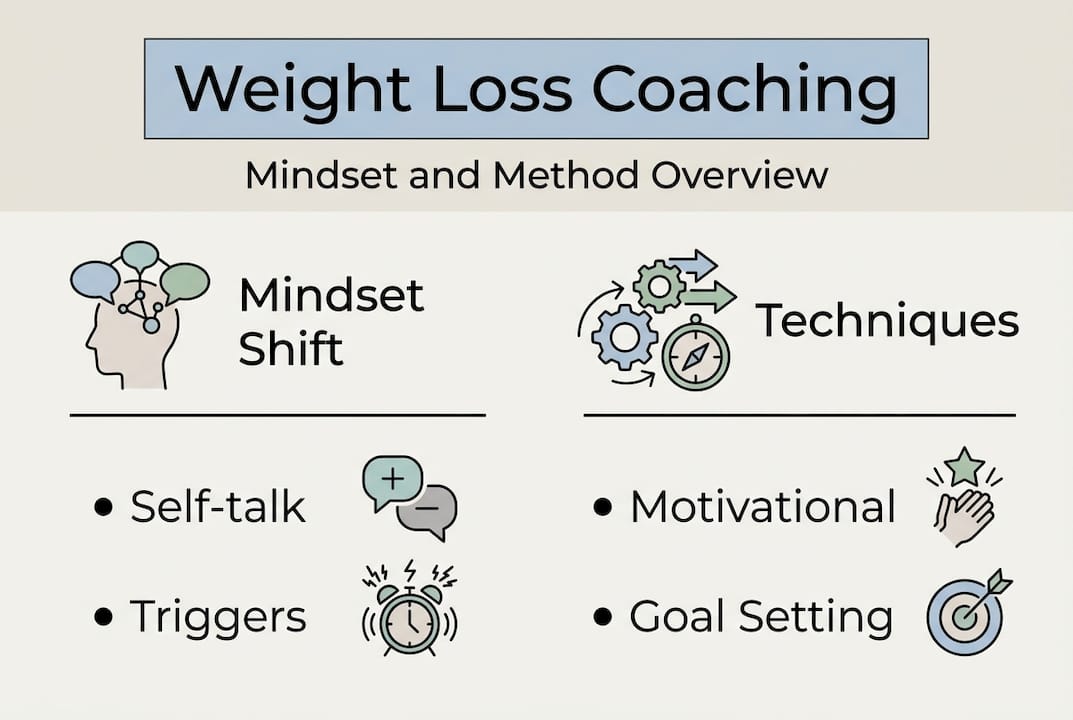
| Technique | What it targets | Real-life example |
|---|---|---|
| Motivational interviewing | Internal motivation | Exploring your personal “why” |
| CBT | Thought patterns | Reframing all-or-nothing thinking |
| Habit stacking | Behavior loops | Pairing walks with lunch breaks |
| SMART goals | Direction and focus | Weekly cooking targets |
For practical mindset shift tips that complement these techniques, it helps to start small and build momentum. And if you want a clear roadmap, a step-by-step weight loss guide can show you how these tools fit together in real life.
Pro Tip: Don’t wait until you feel “ready” to set a goal. Readiness is built through action, not the other way around. Pick one small habit this week and stack it onto something you already do.
Benefits for emotional eaters and long-term changers
If you’re an emotional eater, standard diet advice can feel almost insulting. You already know the salad is the better choice. The problem isn’t information. It’s that food has become a coping mechanism, and no calorie chart addresses that.
This is where mindset coaching becomes genuinely powerful. It works directly with the psychological roots of emotional eating, things like stress responses, dopamine-driven reward loops, and the deeply ingrained habit of using food to manage feelings. Effective for emotional eaters via psychology, coaching addresses the high regain risk that comes without ongoing behavioral support.

CBT and mindfulness-based tools help you recognize the trigger before you’re already elbow-deep in a bag of chips. You start to notice: I’m not hungry. I’m anxious. That pause, that tiny moment of awareness, is everything.
For deeper reading on this, the connection between mindset shifts and emotional eating is worth exploring. And if FOMO-driven eating sounds familiar, there’s a whole piece on overcoming FOMO eating that might hit close to home. For moments when cravings feel overwhelming, learning strategies for managing cravings can make a real difference.
“Coaching doesn’t just change what you eat. It changes how you see yourself as someone who eats.”
The long-term data backs this up. Coaching beats diets for adherence and longevity, which means fewer cycles of yo-yo dieting and more sustained progress over time.
Benefits that show up most for emotional eaters and long-term changers:
- Reduced emotional eating episodes through trigger recognition and response training
- Stronger self-compassion that prevents shame spirals after slip-ups
- Positive routine building that replaces old coping habits with healthier ones
- Better adherence because the approach fits your actual life, not a fantasy version of it
- Less reliance on willpower and more reliance on systems and awareness
Pro Tip: When you notice an emotional eating urge, try naming the emotion out loud before acting on it. “I’m feeling overwhelmed” creates just enough distance between the feeling and the fridge to make a different choice possible.
Limitations, edge cases, and what to expect
Here’s the honest part. Coaching is powerful, but it’s not magic, and it’s not right for every situation without some nuance.
For most people dealing with weight gain driven by lifestyle, habits, and emotional patterns, coaching is a strong fit. But success rates are higher with MI-CBT integration and personalization, and coaching is less effective as a standalone approach for severe obesity where medical or surgical intervention may be needed.
That’s not a knock on coaching. It’s just reality. If you have a complex medical condition driving your weight, you need your doctor in the conversation. Coaching can still play a supporting role, but it shouldn’t be the only tool.
Other things to keep in mind:
- Regain is real. Without ongoing support or continued behavior change, weight regain is common. This is why the best coaching programs build in relapse planning from the start.
- Quick fixes don’t exist here. If you’re expecting dramatic results in two weeks, coaching will disappoint you. Sustainable change is slow by design.
- Customization matters. Generic coaching programs work less well than personalized ones. What works for someone else may not work for you, and a good coach knows that.
- Blended approaches win. Combining coaching with nutrition guidance, movement, and where needed, medical support, produces the best outcomes.
Stat to know: Research consistently shows that behavioral interventions without personalization have significantly lower long-term success rates than tailored, adaptive coaching models.
For those wanting to understand what personalized weight loss actually looks like in practice, it goes well beyond generic advice. And having a plan for handling relapses before they happen is one of the smartest moves you can make.
Set realistic expectations. Progress is not linear. But with the right support, it is absolutely possible.
Our perspective: Why mindset matters more than meal plans
I’ve seen it too many times. Someone follows a perfectly designed meal plan for six weeks, loses weight, then slowly drifts back to old patterns. Not because the plan was wrong. Because nothing changed underneath it.
Diet plans often ignore two things that are almost entirely responsible for long-term success: emotional drivers and identity. If you still see yourself as “someone who struggles with food,” no meal plan will fix that. The identity has to shift first.
True coaching is ongoing and adaptive. It meets you in the messy middle of real life, not the clean version you imagined when you started. It asks uncomfortable questions. It challenges the stories you’ve been telling yourself for years.
The mindset shifts for sustainable weight loss that actually move the needle aren’t about eating less. They’re about thinking differently. About who you are, what you deserve, and what’s actually possible for you.
Lasting results come from inner change. Not information overload.
Start your sustainable weight loss journey
If this resonated with you, you’re probably ready for something more than another diet. You’re ready to work on the part that actually drives the results.
At Mindset Over Menu, we help you build the mindset and habits that make weight loss feel sustainable, not like a constant battle. Whether you’re navigating emotional eating, dealing with a relapse, or just starting out, there’s support here for you. Explore practical strategies for overcoming relapse, learn what it takes for maintaining weight loss long term, or reach out for sustainable weight loss support tailored to your real life. The work starts from the inside.
Frequently asked questions
Do I need to see a weight loss coach in person, or can it be virtual?
You can benefit from weight loss coaching both in person and virtually. Coaching models vary widely, including fully remote formats, so flexibility is built into most modern programs.
How quickly should I expect results from coaching?
Sustainable results typically take several months of consistent work. Long-term behavior change is the goal, not rapid short-term loss, so steady progress is a sign it’s working.
Can weight loss coaching work if I have severe obesity or medical issues?
Coaching can absolutely help, but for severe obesity or complex health conditions, it works best alongside medical treatment. Standalone coaching is less effective when significant clinical needs are present.
What’s the difference between weight loss coaching and a personal trainer?
Weight loss coaching focuses on mindset, behavior, and emotional patterns, while personal trainers guide exercise and fitness. Coaches focus on behavioral change and intrinsic motivation, not just physical activity.
Recommended
- How to maintain weight loss: mindset strategies 2026
- Master mindset shift tips for lasting weight loss
- Why mindset shifts unlock lasting weight loss success
- Step-by-step mindset shifts for sustained weight loss