
Most people trying to lose weight are playing the wrong game. They count calories, white-knuckle their way through cravings, and rely on willpower like it’s an unlimited resource. Then life gets hard, stress shows up, and the whole plan falls apart. Sound familiar? Here’s what most diet programs won’t tell you: the real driver of lasting weight loss isn’t discipline. It’s identity. Small, consistent actions act as ‘votes’ for a new identity, gradually shifting how you see yourself from someone who struggles with weight to someone who simply lives healthy. That shift changes everything.
Table of Contents
- Why identity matters more than willpower
- How identity change anchors healthy habits
- What the evidence shows: Identity, mindset, and sustained weight loss
- Identity-focused approaches vs. other weight loss methods
- Applying identity change: Practical steps for your journey
- Take your next step toward real change
- Frequently asked questions
Key Takeaways
| Point | Details |
|---|---|
| Identity shapes habits | How you see yourself guides your daily decisions around food and activity. |
| Small actions build identity | Consistent, simple behaviors are the most powerful way to become a healthier person over time. |
| Combine mindset and strategy | Blending identity work with proven behavioral tools increases your chances of lasting weight loss. |
| Ongoing maintenance is essential | Long-term success requires seeing identity change as a lifelong process, not a one-time fix. |
Why identity matters more than willpower
Here’s the thing about willpower. It’s not a personality trait. It’s a resource, and it runs out. Under stress, poor sleep, or emotional overload, willpower is usually the first thing to go. And when it’s gone, old habits rush back in like they never left.
Identity works differently. Your identity is your unconscious self-description. It’s the story you tell yourself about who you are. And that story quietly guides your decisions all day long, without you even noticing.
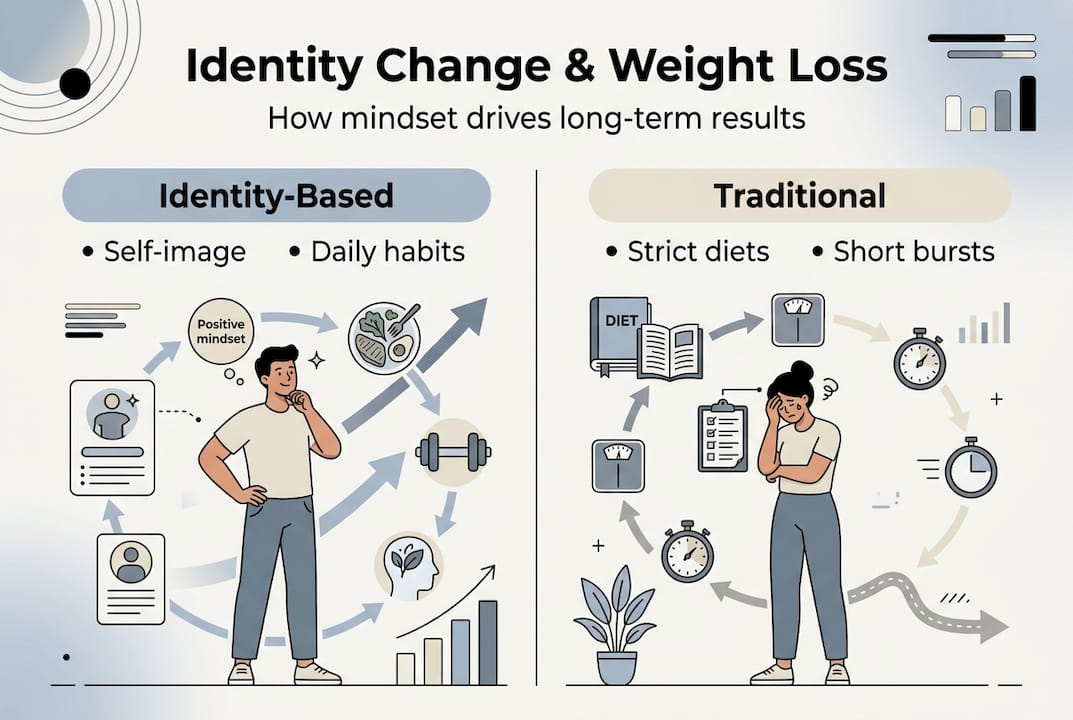
When someone sees themselves as “a healthy person,” they don’t need to debate whether to take the stairs or grab a salad. It just fits who they are. But when someone sees themselves as “someone trying to lose weight,” every healthy choice feels like a fight.
Identity shifts via small habits create subconscious alignment, which actually reduces self-sabotage. That self-sabotage you’ve been blaming yourself for? It’s often just your brain protecting the identity it already believes is true.
Here’s what identity-driven change looks like in practice:
- Willpower-based: “I have to eat salad even though I hate it.”
- Identity-based: “I’m someone who takes care of my body, so I choose foods that make me feel good.”
- Willpower-based: “I need to force myself to exercise.”
- Identity-based: “I’m an active person. Movement is just part of my day.”
“Every action you take is a vote for the type of person you wish to become.” This is the core of identity-based change, and it’s more powerful than any meal plan.
Pro Tip: Next time you make a healthy choice, say to yourself: “That’s just what I do. That’s who I am.” It sounds small. But over time, it rewires the story.
If you want to go deeper on this, mindset shifts for weight loss are a great place to start exploring how your thinking patterns shape your results.
How identity change anchors healthy habits
Now that we’ve connected identity and automatic behaviors, let’s see how to actually shift your identity in daily life.

Think of every healthy action as a vote. Not a grand gesture. Just a vote. You don’t need a perfect week. You need enough votes to start building a new story about yourself.
Small, consistent actions vote for your new identity, and those votes accumulate. Here’s how that looks step by step:
- Track your meals for one week. Not to restrict, but to tell yourself: “I’m someone who pays attention to what I eat.”
- Take a 10-minute walk each morning. Not for calories burned, but to reinforce: “I’m an active person.”
- Choose water over soda once a day. Small vote. Real identity shift.
- Prep one healthy meal per week. You’re not on a diet. You’re someone who cooks for their health.
Here’s a comparison that makes this crystal clear:
| Approach | Motivation | Sustainability |
|---|---|---|
| “I want to lose weight” | External, outcome-based | Low, fades after setbacks |
| “I’m becoming a healthy person” | Internal, identity-based | High, self-reinforcing |
| “I’m on a diet” | Temporary, rule-based | Very low, ends with the diet |
| “I’m someone who moves daily” | Identity-rooted | High, becomes automatic |
The difference isn’t just semantic. It’s psychological. External goals feel like pressure. Identity feels like home.
Pro Tip: Start with one identity statement. Write it down. “I am someone who moves my body every day.” Then find the smallest possible action that proves it true. That’s your first vote.
For more on building this kind of foundation, check out building weight loss habits and daily weight management habits for practical frameworks you can start using today.
What the evidence shows: Identity, mindset, and sustained weight loss
Having reviewed the evidence and what successful maintainers do, let’s clear up confusion on different methods and where identity fits among them.
This isn’t just feel-good theory. The research backs it up.
A study of 508 participants in a 3-month intervention found that psychological flexibility boosts weight loss outcomes and mental health gains. Even more striking, cognitive changes like reducing irrational beliefs predicted weight loss success at 12 months in people with severe obesity. Your thinking patterns literally shape your physical results.
The National Weight Control Registry, which tracks people who have lost 30 or more pounds and kept it off, shows that long-term maintainers use self-monitoring and consistent daily behaviors as their foundation. Not crash diets. Not extreme willpower. Consistent, identity-aligned actions.
| Factor | Short-term impact | Long-term impact |
|---|---|---|
| Strict dieting | High initial loss | High regain risk |
| Willpower alone | Moderate | Low, depletes under stress |
| Mindset and identity work | Moderate initial | High, self-sustaining |
| Combined behavioral and mindset | High | Highest sustained results |
Here’s the honest part: long-term weight regain is common. Most clinical studies show that without ongoing mindset work, weight comes back. Identity change isn’t a one-time fix. It’s a practice.
The good news? Every day is another chance to cast votes. For more on keeping the momentum going, mindset strategies for maintenance and long-term weight loss success offer real, practical guidance.
Identity-focused approaches vs. other weight loss methods
Now that you know how identity fits with other proven strategies, let’s see how to put all this together in your real life.
Popular psychology, especially James Clear’s work, puts identity at the center of behavior change. Clinical psychology takes a different angle. It uses tools like the transtheoretical model (stages of change), motivational interviewing, cognitive behavioral therapy (CBT), and acceptance and commitment therapy (ACT). These focus more on thoughts, behaviors, and readiness to change.
Identity as an enhancer works best when layered on top of these evidence-based methods, not as a replacement for them.
| Method | Core focus | Identity role |
|---|---|---|
| CBT | Changing thought patterns | Indirect |
| Motivational interviewing | Building readiness | Moderate |
| ACT | Acceptance and values | Strong alignment |
| Identity-based habits | Self-concept shift | Central |
ACT is worth highlighting here. ACT matches or exceeds standard behavioral weight loss programs and is especially useful for emotional eating and weight stigma. It helps you stop fighting your thoughts and start acting from your values instead.
Here’s what this means for you:
- Identity work amplifies whatever method you’re already using.
- You don’t have to choose between mindset and structure. Use both.
- If emotional eating is your challenge, ACT-based approaches are worth exploring.
- No single method works for everyone. Flexibility is a feature, not a flaw.
The goal isn’t to find the perfect program. It’s to find the approach that helps you see yourself differently, and then act from that new self-image consistently.
For practical ways to apply this, mindset shift tips and a holistic weight loss guide can help you see the full picture.
Applying identity change: Practical steps for your journey
Let’s wrap up with a clear action plan. Four steps. Simple. Doable. Real.
-
Clarify the identity you want. Not the outcome. The person. “I am someone who moves their body daily.” “I am someone who eats in a way that respects my health.” Write it down. Say it out loud. Get specific.
-
Choose your smallest possible vote. What’s one tiny action that proves this identity true? A 5-minute walk. One glass of water before coffee. One vegetable at dinner. Small is not weak. Small is sustainable.
-
Track and celebrate each action. Not the scale. The action. Every time you follow through, you’re casting a vote. Acknowledge it. “I did that. That’s who I am.” Self-monitoring combined with identity work is one of the strongest predictors of long-term success.
-
Expect setbacks and reframe them. You will have off days. That doesn’t mean you failed. It means you’re human. The identity-based response isn’t “I ruined everything.” It’s “That wasn’t like me. Let me get back to who I am.”
This is the shift that makes everything else easier. Not perfect. Easier.
Pro Tip: After a setback, ask yourself: “What would a healthy person do next?” Then do that one thing. One vote is enough to restart the momentum.
For real-world application, the real-life weight loss guide and accountability for weight loss resources are packed with tools to keep you moving forward.
Take your next step toward real change
If this article sparked something in you, that’s not an accident. Identity-based change is one of the most underused tools in weight loss, and it’s exactly what we focus on at Mindset Over Menu.
Whether you’re just starting out or you’ve been stuck in the same cycle for years, the right mindset support can change the trajectory. Explore mindset strategies for maintenance to keep your progress going strong. Dig into sustainable weight loss habits for a long-term framework that actually fits your life. And if you’re ready to shift how you think about yourself and your health, mindset shift tips is a great next read. You’re not starting over. You’re starting from experience.
Frequently asked questions
How long does it take to shift your identity for weight loss?
Identity change develops gradually over weeks and months as repeated small actions reinforce your chosen self-image. There’s no fixed timeline, but consistency matters far more than speed.
What’s the biggest mistake people make when trying to lose weight?
The most common mistake is relying on willpower or strict rules instead of building an identity that naturally supports healthy choices. Subconscious alignment through habits is what makes change stick long-term.
Are identity-based approaches more effective than standard programs?
They can make evidence-based strategies more sustainable, but identity as an enhancer works best when combined with structured programs, not used as a standalone replacement.
Can this approach help with emotional or binge eating?
Yes. Acceptance-based methods like ACT, which align closely with identity work, match or exceed standard behavioral programs and are especially effective for emotional eating and reducing weight-related stigma.
Recommended
- How to maintain weight loss: mindset strategies 2026
- Real-life weight loss guide: 5-10% success in 2026
- Sustainable weight loss: Habits, mindset, and long-term success
- Accountability in weight loss: unlock lasting change