
Most diets don’t fail because you lack knowledge. They fail because the mindset underneath never changed. You can follow the cleanest meal plan in the world, but if your inner dialogue is still running the old script, most regain weight after initial loss without sustainable mindset strategies in place. This guide maps out a practical, evidence-backed roadmap through each psychological stage of change. You’ll learn how to recognize where you’re stuck, build habits that actually last, and sidestep the traps that derail most people before they ever reach maintenance.
Table of Contents
- Understand the mindset shift journey
- Step 1: Build awareness (precontemplation to contemplation)
- Step 2: Prepare for action through intention and planning
- Step 3: Take action with evidence-based strategies
- Step 4: Maintain, troubleshoot, and make your shift automatic
- Expected outcomes and how to measure progress
- Take your mindset shift further: Resources from Mindset Over Menu
- Frequently asked questions
Key Takeaways
| Point | Details |
|---|---|
| Mindset over willpower | Lasting weight loss depends on shifting your mindset, not just relying on determination. |
| Stepwise process | Effective change moves through awareness, preparation, action, and maintenance stages. |
| Evidence-based tools | Techniques like self-monitoring, SMART goals, and motivational interviewing boost results. |
| Flexible habits win | A growth mindset and psychological flexibility make habit change more automatic and resilient. |
| Relapse is normal | Setbacks and plateaus are expected; the key is to reflect, reset, and keep progressing. |
Understand the mindset shift journey
Before you can change anything, you need to know where you are. Think of it like a GPS. You can’t get directions without a starting point.
The Transtheoretical Model (TTM) gives us exactly that. It maps mindset shift steps across five psychological stages: precontemplation, contemplation, preparation, action, and maintenance. Each stage has its own challenges, its own pace, and its own set of tools that actually work.
Here’s a quick look at what each stage looks like in real life:
| Stage | What it feels like | Common barrier | Best strategy |
|---|---|---|---|
| Precontemplation | “I don’t have a problem” | Denial or low awareness | Consciousness-raising |
| Contemplation | “Maybe I should change” | Ambivalence | Motivational interviewing |
| Preparation | “I’m getting ready” | Perfectionism, vague goals | SMART planning |
| Action | “I’m doing it” | Burnout, all-or-nothing thinking | Habit stacking, flexibility |
| Maintenance | “This is my life now” | Relapse, boredom | Self-compassion, review cycles |
Most people jump straight to action without doing the inner work first. That’s why behavioral changes research consistently shows that skipping stages leads to early dropout.
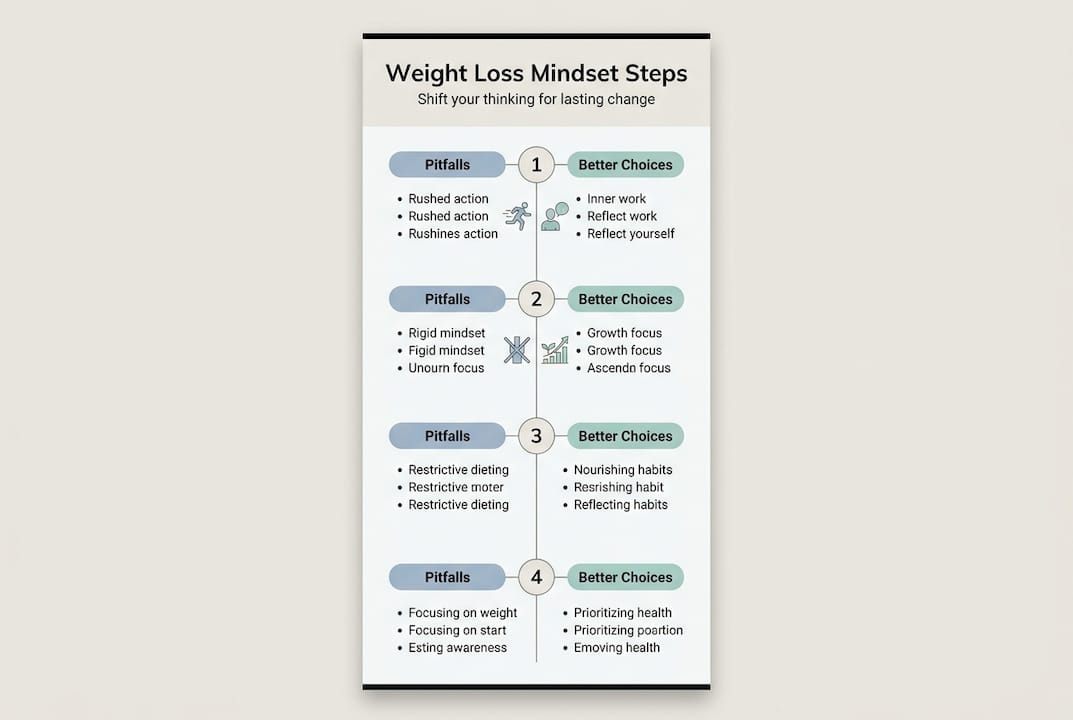
Two mindset styles also play a huge role here. A rigid mindset says: “I broke my diet, so the day is ruined.” A growth mindset says: “That happened. What can I learn?” The mindset shift benefits for emotional eaters especially come from learning to hold setbacks loosely rather than catastrophizing them.
The key insight? You don’t need to rush through stages. You need to work with where you are.
Step 1: Build awareness (precontemplation to contemplation)
With the mindset roadmap clear, the first step is self-awareness. Nothing sticks until you recognize what actually needs to change.
Here are some signs you might be in precontemplation or contemplation right now:
- You know you “should” eat better but feel no real urgency
- You’ve started and stopped the same plan multiple times
- You feel defensive when the topic of weight comes up
- You want to change but can’t quite commit to a first step
Sound familiar? That’s not weakness. That’s ambivalence. And consciousness-raising and motivational interviewing are specifically designed to help you move through it.
Here’s a simple numbered process to build awareness:
- Start a reflection journal. Write three sentences each morning about how you feel in your body and what you’re telling yourself about food.
- Identify your triggers. What situations, emotions, or environments push you toward old habits?
- List your current beliefs. Write down what you actually believe about your ability to change. Be honest.
- Note your past wins. What has worked before, even briefly? What did that feel like?
This isn’t about fixing anything yet. It’s about seeing clearly.
Willpower alone won’t produce lasting change. Recognizing ambivalence is a strength, not a flaw.
Pro Tip: Ask yourself these motivational interviewing questions: “What would need to be true for me to feel ready?” and “What’s one small thing I could do this week that wouldn’t feel overwhelming?” Motivational interviewing can boost weight loss by supporting your intrinsic drivers rather than forcing external pressure.
Building this awareness is also the foundation for maintaining healthy changes long-term. You can’t maintain what you never truly understood.
Step 2: Prepare for action through intention and planning
Once you recognize you’re ready to change, it’s time to get concrete. Awareness without a plan is just a good intention that fades by Thursday.
Preparation means building the bridge between “I want to” and “I know exactly how.” Start with three things:
- Visualize your outcome. Not just the number on the scale. How do you want to feel in six months? What does a normal Tuesday look like for you then?
- Write your “why” list. Go deeper than “I want to lose weight.” Why does that matter? What changes in your life when it happens?
- Create a commitment statement. Something like: “I’m choosing to build habits that support my energy and health, one day at a time.”
Now, here are the barriers that most often derail people at this stage:
- Perfectionism (“I’ll start when everything is perfect”)
- Vague goals (“I want to eat healthier” with no specifics)
- Overcommitting too fast
- Fear of failure disguised as “more research”
Self-efficacy and preparation for lasting behavior change improve dramatically when goals are realistic and specific. Here’s what that looks like in practice:
| Area | Vague goal | SMART goal |
|---|---|---|
| Nutrition | Eat less junk food | Swap afternoon chips for fruit 4 days a week |
| Activity | Exercise more | Walk 20 minutes after dinner on weekdays |
| Self-talk | Be more positive | Replace “I failed” with “I’m learning” daily |
SMART goal setting and self-monitoring lead to measurably better weight loss outcomes at 12 months. That’s not motivational fluff. That’s data.

Pro Tip: Don’t wait for the “action” stage to start tracking. Begin a simple food and mood log now, during preparation. It builds the habit early and gives you real data to work with when you’re ready to move forward. Check out this weight loss action plan and holistic approach guidance for more structure.
Step 3: Take action with evidence-based strategies
Preparation leads directly into the work of daily action. Here’s how to turn plans into habits that endure.
This is where most people think the magic happens. And it does, but not in the way you’d expect. The magic isn’t motivation. It’s repetition, structure, and self-talk.
Here’s a numbered approach to building action that sticks:
- Track daily. Use a food and mood log. Not to judge yourself, but to see patterns. What time of day do cravings spike? What emotions show up before you reach for comfort food?
- Control your environment. Remove friction from healthy choices. Put the fruit on the counter. Move the snacks out of sight. Your environment is either working for you or against you.
- Practice positive self-talk. When you slip, the inner critic shows up fast. Counter it with: “That happened. I’m still in this.”
- Build flexible routines. Rigid plans break. Flexible ones bend. Aim for consistency, not perfection.
Self-monitoring, cognitive restructuring, and positive self-talk predict greater 12-month weight loss outcomes. These aren’t soft skills. They’re the actual mechanism of change.
Behavioral programs yield 5 to 10% weight loss at 6 to 12 months. Most regain occurs without a maintenance strategy.
Pro Tip: Track your feelings alongside your food. “I ate well today and felt proud” is just as important as the calorie count. Process tracking builds emotional awareness, which is the real engine behind beginner habit strategies and daily habit tools that last.
Step 4: Maintain, troubleshoot, and make your shift automatic
Action creates momentum, but long-term success is all about sustaining and troubleshooting your shift until it becomes second nature.
This is the stage most programs ignore. They get you to action and then leave you there. But maintenance is its own skill set.
Key practices that support this stage:
- Mindfulness. Slow down before meals. Check in with hunger and fullness. Mindful eating and psychological flexibility reduce emotional barriers and support positive emotions over time.
- Self-compassion. Talk to yourself like you’d talk to a friend who’s struggling. Harsh self-judgment is a relapse trigger, not a motivator.
- Environmental design. Keep your environment set up for the person you’re becoming, not the habits you’re leaving behind.
- Psychological flexibility. A growth-oriented mindset leads to automaticity, higher habit retention, and better long-term success.
Common setbacks and how to troubleshoot them:
- Plateau: Reassess your habits, not your worth. What’s drifted? What needs a small tweak?
- Emotional eating: Return to your trigger journal. What’s the emotion underneath the craving?
- Old triggers resurfacing: Expect them. Plan for them. They’re not a sign you’ve failed. They’re a sign you’re human.
The goal isn’t perfection, but flexibility and self-compassion.
Pro Tip: Every two weeks, do a quick self-assessment. Ask: “What worked? What didn’t? What’s one thing I’ll adjust?” This iterative loop is how you stay on track without burning out. Pair it with these mindset maintenance techniques for a complete toolkit.
Expected outcomes and how to measure progress
With the steps in place, it’s critical to know what to look for as proof of true progress, and how to reset if momentum slips.
Here’s what realistic progress actually looks like:
| Approach | Typical weight loss | Maintenance rate | Key factor |
|---|---|---|---|
| Behavioral program | 5 to 10% in 6 to 12 months | Higher with ongoing support | Habit consistency |
| Restrictive diet | Fast initial loss | Low long-term retention | Willpower dependent |
| Unstructured effort | Variable | Very low | No system in place |
Progress isn’t only the scale. Non-scale victories matter just as much:
- Sleeping better
- Feeling less anxious around food
- Choosing a walk because you want to, not because you have to
- Catching negative self-talk before it spirals
Relapses are normal. Most people experience them. The difference between those who succeed long-term and those who don’t isn’t whether they relapsed. It’s how quickly they returned to their process. Check out realistic success stories to see what this looks like in practice.
When momentum slips, don’t restart from zero. Just pick up the next meal, the next walk, the next journal entry. That’s it.
Take your mindset shift further: Resources from Mindset Over Menu
Ready to take the next step in your mindset shift? The journey doesn’t end here, and expert support can keep you moving forward.
At Mindset Over Menu, we’ve built a library of resources specifically designed for people who are done with quick fixes and ready for real, lasting change. Whether you’re just starting to build awareness or you’re deep in the maintenance stage and need a reset, there’s something here for you.

Explore master mindset shift tips for a deeper look at the psychological tools that drive lasting results. If you’re working on staying consistent, the guide on maintaining weight loss mindset walks you through exactly how to keep momentum alive. And if you want a full structured plan, the weight loss guide ties everything together in one place. Personalized coaching with Constantin Liculescu is also available for those who want one-on-one support tailored to their specific barriers and goals.
Frequently asked questions
What is the most important mindset shift for sustainable weight loss?
Embracing a growth mindset is the foundation. Growth mindset predicts higher weight loss success and habit retention because it reframes setbacks as data rather than failure.
How long does it take to see real change from a mindset shift?
Meaningful progress, like habit consistency and 5 to 10% weight loss, can occur in 6 to 12 months. Behavioral programs show these benchmarks consistently when the right strategies are applied.
How do I stay motivated if I relapse into old habits?
Normalize it first. Most experience regain within 2 to 5 years without maintenance strategies, which means relapse is part of the process, not the end of it. Use self-compassion and return to your process.
Is willpower enough for sustainable weight loss?
No. Willpower alone is insufficient for lasting results. Habit formation, self-monitoring, and psychological flexibility are what actually drive change over time.
What practical tools support mindset shifts?
Self-monitoring and SMART goals improve long-term outcomes significantly. Food and mood logs, mindful eating practices, and motivational interviewing prompts are the most effective starting tools.
Recommended
- Master mindset shift tips for lasting weight loss
- Sustainable weight loss: Habits, mindset, and long-term success
- Why mindset shifts unlock lasting weight loss success
- How to maintain weight loss: mindset strategies 2026