
Most people think weight loss is a willpower problem. Eat less, move more, try harder. But if sheer determination were enough, the weight loss success rate would look a lot better than it does. The real game changer is not another diet. It is structured behavior change, the kind that rewires how you think, feel, and act around food and your body. This guide walks you through what behavior change actually means, which models and skills work best, what results are realistic, and how to handle the messy, human parts that most guides skip entirely.
Table of Contents
- What is behavior change in weight loss?
- Core models and methods of behavior change
- Essential skills and techniques for lasting change
- Benchmarks and realities: what results are achievable?
- Nuances, barriers, and what really makes change stick
- A mindset-first approach: what most weight loss guides miss
- Ready to make lasting change? Get support for your journey
- Frequently asked questions
Key Takeaways
| Point | Details |
|---|---|
| Behavior change is foundational | Lasting weight loss comes from changing daily habits, not just restrictive diets. |
| Multiple techniques work together | Combining models like CBT, MI, and self-monitoring leads to better results. |
| Progress takes time | Meaningful change often takes months and emphasizes persistence, not perfection. |
| Mindset and support matter | Emotional skills and community help break cycles and boost long-term results. |
What is behavior change in weight loss?
Let’s be honest. Most diets work. For a while. The problem is not the plan. It is what happens after the novelty wears off and real life shows up.
Behavior change refers to structured strategies aimed at modifying habits and thinking for sustainable weight loss and maintenance. It covers three big areas: eating patterns, physical activity, and the cognitive stuff, meaning how you think about food, your body, and yourself.
This is very different from a traditional diet. Here is a quick comparison:
| Approach | Focus | Typical outcome |
|---|---|---|
| Traditional diet | Food rules and restriction | Short-term loss, frequent regain |
| Behavior change | Habits, mindset, and skills | Gradual, sustainable progress |
| Combined approach | Both structure and psychology | Best long-term results |
Why does this matter? Because over 40% of US adults are affected by overweight or obesity, and most have already tried dieting. The missing piece is rarely another meal plan.
Behavior change is now recommended in clinical guidelines for long-term weight control. It is not a soft alternative to “real” treatment. It is the foundation.
The skills you build through building daily weight loss habits are what make the difference between losing weight and actually keeping it off.
Key areas behavior change addresses:
- Eating behaviors and food choices
- Physical activity and movement patterns
- Emotional responses and stress eating
- Self-talk and cognitive patterns
- Social and environmental triggers
Think of it less like following a program and more like building a new operating system for your daily life.
Core models and methods of behavior change
Understanding the need for behavior change, let’s explore the models that make it possible.
There are three heavy hitters in this space, and each one brings something different to the table.
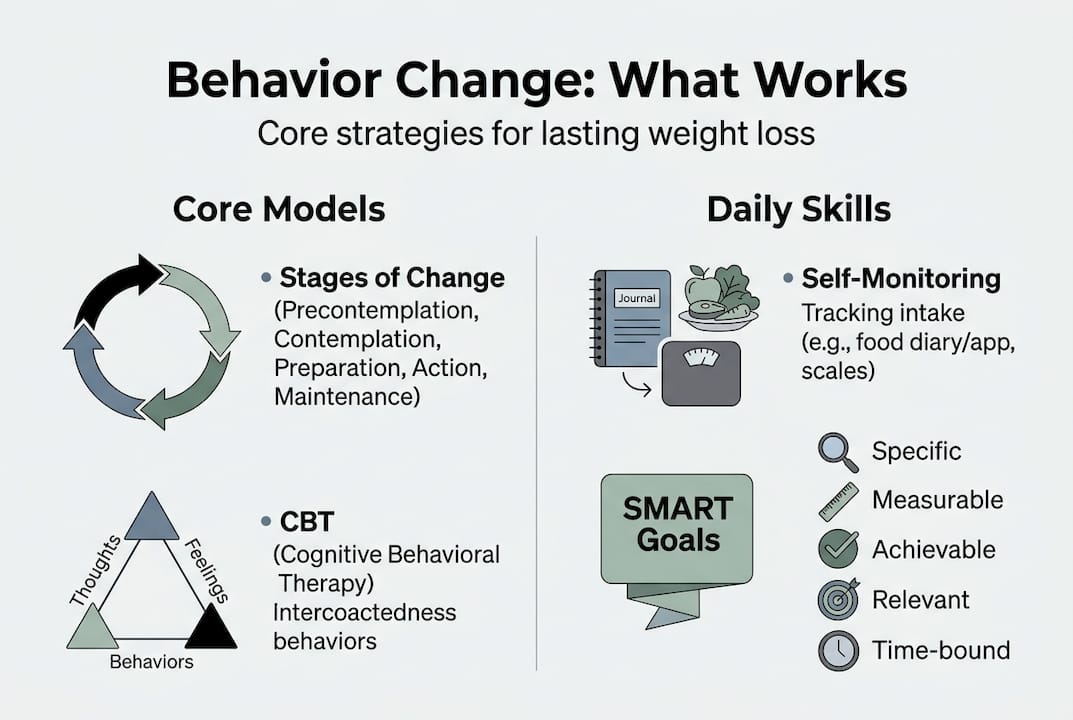
The Transtheoretical Model (Stages of Change) recognizes that people are not all in the same place mentally. Someone who has never thought about changing their eating habits needs different support than someone who has been trying for years. The model maps five stages: precontemplation, contemplation, preparation, action, and maintenance. Meeting people where they are, rather than where you wish they were, is genuinely powerful.
Motivational Interviewing (MI) is a conversation-based method that helps you work through ambivalence. You know that feeling where part of you wants to change and part of you really does not? MI uses the OARS technique, which stands for Open questions, Affirmations, Reflective listening, and Summaries, to help you find your own reasons to move forward. Evidence on MI and CBT shows MI can add nearly 1.5 kg of additional weight loss compared to standard advice alone.
Cognitive Behavioral Therapy (CBT) targets the thinking patterns that keep you stuck. All-or-nothing thinking. “I already ate the cookie, so the day is ruined.” CBT helps you catch those thoughts, question them, and replace them with something more useful. It also addresses relapse, which is not failure. It is data.
These mindset shifts in weight loss are not abstract. They are trainable skills.
The core methods ranked by focus:
- Transtheoretical Model: readiness and stage-matched support
- Motivational Interviewing: resolving ambivalence and building internal motivation
- Cognitive Behavioral Therapy: restructuring thoughts and preventing relapse
- Combined approaches: layering methods for stronger, lasting results
Pro Tip: If you are not sure where to start, ask yourself: “Am I ready to change, or am I still convincing myself?” Your honest answer tells you which model fits right now. Understanding how mindset impacts weight loss is the first real step.
Essential skills and techniques for lasting change
With these methods in mind, it is important to focus on the daily skills that transform theory into lived success.

Knowing about behavior change is one thing. Practicing it is another. Here are the skills that actually move the needle.
Self-monitoring is probably the single most evidence-backed tool available. Tracking what you eat, how you move, and how you feel creates awareness you simply cannot get any other way. Not to judge yourself. To understand yourself.
SMART goals make change manageable. Specific, Measurable, Achievable, Relevant, and Time-bound goals replace vague intentions like “eat better” with something you can actually act on and measure.
Stimulus control means reshaping your environment so healthy choices become easier and tempting ones become harder. Move the fruit bowl to the counter. Keep the chips out of the house. Small environmental shifts reduce the mental effort required every single day.
Cognitive restructuring is the practice of catching unhelpful thoughts and replacing them with more balanced ones. It is not toxic positivity. It is accuracy.
Additional skills that build resilience:
- Social support: leaning on people who encourage your goals
- Problem solving: planning for obstacles before they happen
- Relapse prevention: treating slips as normal, not catastrophic
Over 14 sessions across six months are recommended for behavioral weight management, and research confirms that high-intensity programs with more touchpoints consistently produce better outcomes.
Pro Tip: Do not wait until you feel motivated to track or set goals. Build the habit first. Motivation follows action, not the other way around. Explore long-term weight loss strategies to see how these skills compound over time.
Benchmarks and realities: what results are achievable?
So, what is realistic to expect from a focus on behavior change?
Let’s set honest expectations, because unrealistic ones are one of the biggest reasons people quit.
High-intensity programs can lead to 5 to 8% weight loss in six months, with even a 5% reduction bringing meaningful health benefits, including improved blood pressure, blood sugar, and cholesterol.
| Program intensity | Expected loss (6 months) | Key benefit |
|---|---|---|
| Low intensity (1-5 sessions) | 1 to 3% | Awareness building |
| Moderate intensity (6-13 sessions) | 3 to 5% | Habit formation |
| High intensity (14+ sessions) | 5 to 8% | Clinical health improvements |
“Losing just 5% of your body weight can significantly reduce your risk of type 2 diabetes and cardiovascular disease. That is not a consolation prize. That is a win.”
Here is what most guides leave out: maintenance is harder than loss. Many people hit their goal and then quietly regain the weight because the support structure disappears. This is why strategies for weight loss maintenance deserve as much attention as the loss phase itself.
What influences your results:
- Consistency of engagement with your program
- Quality and frequency of professional or peer support
- Ability to manage emotional triggers and stress
- Realistic expectations from the start
Rapid loss is not the goal. Sustainable change is. And sustainable change looks slower, messier, and more human than any before-and-after photo suggests.
Nuances, barriers, and what really makes change stick
Now that we know what realistic progress looks like, let’s look at how to manage the nuanced challenges that can block lasting change.
Here is the uncomfortable truth: knowing what to do is rarely the problem. Doing it when life is hard, when you are stressed, tired, or emotionally depleted, that is the real challenge.
Emotional eating is one of the most common barriers. Food becomes comfort, distraction, or reward. And no amount of meal planning addresses that until you work on the emotional layer underneath.
Weight stigma is another real obstacle. Internalizing negative messages about your body can actually undermine your motivation and make change feel pointless. Addressing this is not optional. It is essential.
Best long-term outcomes link to targeting emotional barriers, flexible restraint, tailored support, and integrating multiple change techniques. Rigid dieting, the “I can never eat that” approach, tends to backfire. Flexible thinking, where you make room for real life without abandoning your goals, works far better.
What actually makes change stick:
- Targeting emotional triggers, not just food choices
- Using flexible rather than rigid food rules
- Choosing programs that are tailored to your life, not generic
- Building accountability into your routine
- Combining multiple behavior change techniques
Pro Tip: If you keep “falling off the wagon,” the wagon might be the problem. Rigid plans create rigid failures. Build a flexible framework instead. Understanding your emotional triggers and weight loss patterns is where real progress begins, and the importance of accountability keeps you honest when motivation dips.
“The goal is not perfection. It is consistency with compassion.”
A mindset-first approach: what most weight loss guides miss
Here is what I have seen over and over again. People come in armed with the perfect plan. Macros calculated. Workouts scheduled. Meal prep done on Sunday. And then Thursday happens.
A stressful meeting. A bad night’s sleep. An argument. And suddenly the plan feels impossible.
Dieting alone creates short-term change. Real transformation anchors in habits and self-belief. That is not a motivational poster. It is just true.
The guides that focus only on what to eat miss the entire emotional and psychological architecture that either supports or sabotages your efforts. Emotional resilience, the ability to feel a hard feeling without immediately reaching for food, is a skill. It is trainable. And it matters more than any specific diet.
I also think we underestimate the power of identity change for weight loss. When you start to see yourself as someone who takes care of their body, not someone who is “trying to lose weight,” everything shifts. Behavior change is not a six-week program. It is a lifelong practice of flexibility, self-compassion, and community.
Mindset is not the soft stuff. It is the foundation.
Ready to make lasting change? Get support for your journey
If this article has you thinking differently about weight loss, that is exactly the point. Understanding the psychology is step one. Applying it with support is where the real work happens.
At Mindset Over Menu, we help you understand and overcome setbacks so they do not derail your progress, and we give you the tools to maintain your weight loss long after the initial motivation fades. Whether you are just starting out or rebuilding after a setback, Mindset Over Menu offers personalized coaching and practical resources built around behavior change, not another diet. You deserve support that actually fits your life.
Frequently asked questions
What are the main behavior change strategies for weight loss?
Core techniques include self-monitoring, SMART goals, stimulus control, cognitive restructuring, problem-solving, and relapse prevention, typically delivered across multiple sessions for the best results.
How long does behavior change for weight loss take to show results?
High-intensity programs show 5 to 8% weight loss at six months, but true maintenance requires sustained effort and support for a year or more.
Can behavior change help with emotional eating?
Yes. Techniques like CBT and motivational interviewing directly address emotional eating by building self-awareness and resilience. Emotional eating interventions show significant improvement through structured behavioral change approaches.
Is behavior change enough for lasting weight loss or do I need medical support?
Behavior change is essential, but some people benefit from additional medical or professional input, especially when biological or psychological factors are involved. Some reviews caution against relying solely on behavior change in complex cases.
What makes behavior change sustainable?
Individual tailoring and sustained support are the strongest predictors of long-term success, alongside regular self-monitoring, flexible thinking, and a strong support system around you.
Recommended
- Step-by-step mindset shifts for sustained weight loss
- Master mindset shift tips for lasting weight loss
- Why mindset shifts unlock lasting weight loss success
- Sustainable weight loss: Habits, mindset, and long-term success