TL;DR:
- Self-awareness helps recognize food triggers and emotional patterns for sustainable weight loss.
- Building self-awareness through journaling, mindfulness, or apps improves habits and emotional regulation.
- Awareness alone isn’t enough; pairing it with flexible restraint and self-compassion is essential.
Most diets hand you a meal plan and call it a day. But if willpower and calorie counts were enough, you wouldn’t be here. The real missing piece? Self-awareness, through self-monitoring, is a core behavioral strategy consistently linked to greater weight loss outcomes. Not the “eat less, move more” kind of awareness. The kind that helps you notice why you reached for the chips at 9pm, what emotion was sitting underneath that craving, and what pattern keeps showing up every single week. This guide breaks down the science, the tools, and the mindset shifts that make self-awareness your most powerful asset for lasting change.
Table of Contents
- Why self-awareness is foundational to sustainable weight loss
- How self-awareness disrupts emotional eating and automatic behaviors
- Proven strategies to build self-awareness in your daily routine
- What research reveals: Benchmarks, limitations, and cultural nuances
- A fresh perspective on self-awareness and weight loss: Why most advice misses the mark
- Ready to turn self-awareness into lasting results?
- Frequently asked questions
Key Takeaways
| Point | Details |
|---|---|
| Self-awareness drives results | Consistent self-monitoring leads to greater and more sustainable weight loss than following generic diets. |
| Tackle emotional eating | Self-awareness helps you recognize emotional triggers so you can choose healthier responses instead of eating automatically. |
| Use practical self-awareness tools | Journals, mindfulness, and apps are easy strategies to build daily self-awareness and steady progress. |
| Set realistic expectations | Weight loss outcomes vary; self-awareness improves habits for most, but results depend on effort and context. |
| Combine insight with action | Self-awareness alone isn’t enough—combine it with flexible plans, self-compassion, and goal-oriented action for true change. |
Why self-awareness is foundational to sustainable weight loss
Self-awareness, in the context of weight loss, means recognizing your thoughts, triggers, and patterns around food, movement, and emotion. Not judging them. Just seeing them clearly.
And that clarity? It changes everything.
When you know what drives your eating, you stop being on autopilot. You start making choices instead of just reacting. That’s the shift that makes sustainable weight loss habits actually stick.
The research backs this up in a big way. Higher adherence to self-monitoring predicts at least 5% weight loss, with odds ratios reaching as high as 17.77. That’s not a small effect. That’s the difference between spinning your wheels and actually moving forward.
Here’s a snapshot of what the data shows:
| Self-monitoring behavior | Outcome |
|---|---|
| Consistent food tracking | 5%+ weight loss predicted |
| High adherence to journaling | Odds ratio up to 17.77 for success |
| Mindful eating practice | Reduced emotional eating, lower BMI association |
| mHealth app use | ~1.85kg greater loss vs. controls at 6 months |
So why do most diets skip this? Because it’s easier to sell a food list than to help someone understand themselves.
Here are the most common barriers self-awareness helps you address:
- Emotional eating: Stress, loneliness, or boredom disguised as hunger
- Automatic habits: Eating while scrolling, finishing the plate out of habit, not actual fullness
- Social pressure: Eating to fit in, people-pleasing at the dinner table
- All-or-nothing thinking: One “bad” meal becomes a reason to abandon the whole week
Rigid self-control, the white-knuckle kind, tends to crack under pressure. Self-awareness, on the other hand, builds a foundation that holds. Because you’re not fighting yourself. You’re understanding yourself.
How self-awareness disrupts emotional eating and automatic behaviors
Emotional eating doesn’t knock politely before it arrives. It shows up like an uninvited guest who brought friends: stress from work, a tough conversation, a quiet Tuesday evening that feels heavier than it should.

And before you know it, you’re halfway through a bag of something crunchy, wondering how you got there.
This is where self-awareness becomes a game-changer. Mindful eating increases awareness of hunger and satiety cues, reduces emotional eating, and is negatively associated with BMI. The key mechanism is the pause. That tiny moment between the urge and the action.
“Mindful eating components like sensory attention are linked to greater self-compassion, which helps break the shame cycle that often follows emotional eating.”
That pause is a skill. And like any skill, you can build it.
Here’s a simple way to interrupt an emotional eating pattern using awareness:
- Notice the urge. Before you open the fridge, stop. Just notice. “I want to eat right now.”
- Name the emotion. Is it hunger? Stress? Boredom? Loneliness? Don’t judge it. Just label it.
- Check in with your body. When did you last eat? Are you physically hungry or emotionally hungry?
- Choose consciously. You might still eat. That’s okay. But now it’s a choice, not a reaction.
- Reflect afterward. What happened? What triggered it? What could you do differently next time?
This process builds what I like to call the “muscle of resistance.” Not the kind that says no to everything. The kind that gives you a second to think before you act.
For more on building healthy weight loss habits around emotional patterns, and for deeper mindset shifts for emotional eaters, these resources go further into the practical side of this work.
Pro Tip: Before your next meal or snack, take 10 seconds to label your current emotion out loud or in writing. Just one word. “Tired.” “Anxious.” “Bored.” That tiny act of labeling interrupts the automatic loop and creates space for a conscious choice.
Proven strategies to build self-awareness in your daily routine
Knowing you need self-awareness is one thing. Building it into your actual day is another. The good news: you don’t need to overhaul your life. You just need a few consistent practices.
Food and mood journals, apps, mindfulness-based eating awareness training, and cognitive restructuring all build self-awareness and support measurable weight loss. And mHealth self-regulation apps led to an average 1.85kg greater weight loss at 6 months compared to controls. That’s real-world impact from a tool you can use on your phone.
Here’s how the main approaches compare:
| Method | Best for | Effort level | Key benefit |
|---|---|---|---|
| Food and mood journal | Pattern recognition | Low to medium | Connects emotions to eating |
| Mindfulness training | Slowing automatic responses | Medium | Builds the pause reflex |
| Digital tracking apps | Consistency and data | Low | Keeps you accountable daily |
| Cognitive restructuring | Changing thought patterns | Medium to high | Rewires limiting beliefs |
Here’s how to start without overwhelming yourself:
- Pick one method to begin with. A simple notes app works fine.
- Log what you eat, when, and how you felt before and after. Three data points. That’s it.
- Review your log at the end of each week. Look for patterns, not perfection.
- Add a second method (like a mindfulness check-in) only after the first feels natural.
Some tools and techniques worth exploring:
- Apps: MyFitnessPal, Ate Food Journal, Noom (for mood and behavior tracking)
- Templates: A simple three-column journal: food, time, emotion
- Techniques: Body scan before meals, hunger scale (1 to 10), the HALT check (Hungry, Angry, Lonely, Tired)
For a deeper look at how mindset shapes your approach, the personalized weight loss mindset guide is a great next read.
Pro Tip: Consistency beats perfection every single time. Tracking 5 out of 7 days with honesty is worth more than tracking 7 out of 7 days with shame. Use your journal as a mirror, not a report card.
What research reveals: Benchmarks, limitations, and cultural nuances
Let’s be real with each other. Self-awareness is powerful. But it’s not magic. And the research is honest about that.
Here’s what the evidence actually shows:
| Intervention | Expected outcome |
|---|---|
| Consistent self-monitoring | 5 to 9% weight loss |
| mHealth app interventions | ~1 to 2kg additional loss |
| Mindful eating programs | Behavior improvements, modest weight change |
Self-monitoring adherence predicts 5 to 9% weight loss, mHealth interventions yield about 1 to 2kg, and mindful eating trials show behavior improvements but not always significant weight loss on the scale. That last part is important.
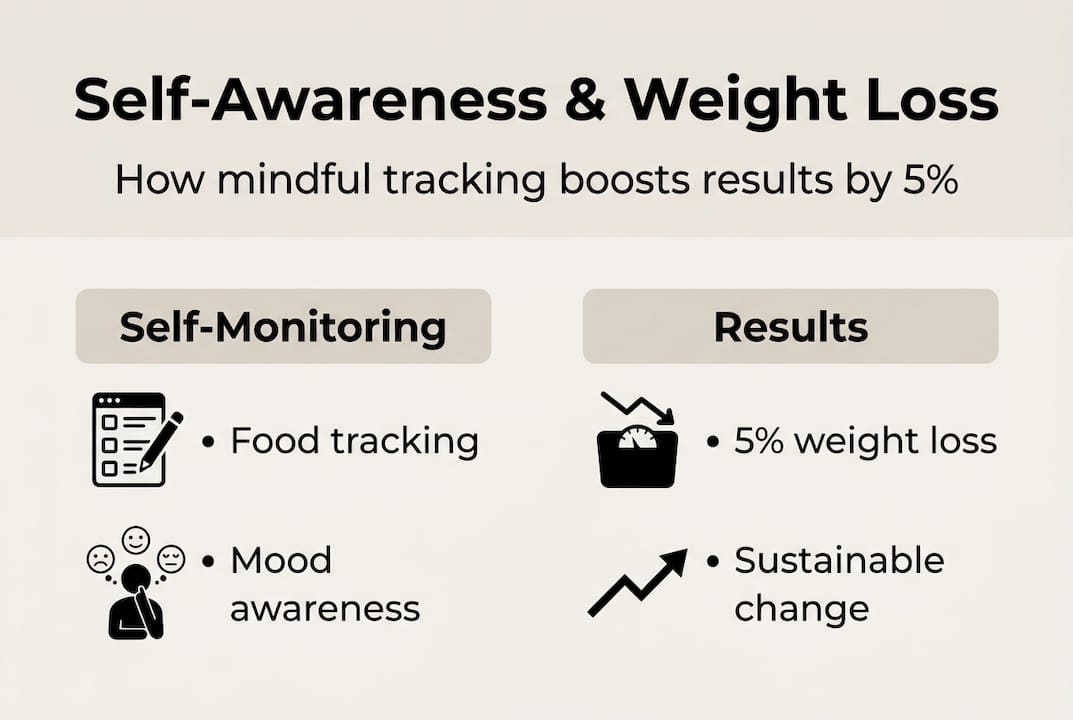
The scale doesn’t always tell the full story. Improved eating behaviors, reduced emotional eating, better sleep, and more energy are real outcomes, even when the number moves slowly.
Some common challenges that affect results:
- Holiday and social eating: Adherence tends to drop during high-pressure social periods
- Eating concern vs. weight concern: Some people become more anxious about food, not less, when tracking obsessively
- Baseline mindset: Someone starting with a lot of shame around food may need more support before self-monitoring feels safe
“Mindful eating is more effective for emotional regulation than for producing absolute weight loss, making it a foundational tool rather than a standalone solution.”
Culture matters too. Self-consciousness can buffer against weight bias, but effects vary by country and cultural context. What feels empowering in one environment may feel shaming in another. Your results will be shaped by your starting point, your history, and your support system.
Progress is measurable in habits and in weight. But the timeline is yours. For more on building daily habits for weight management and understanding step-by-step mindset shifts, both are worth bookmarking.
A fresh perspective on self-awareness and weight loss: Why most advice misses the mark
Here’s the uncomfortable truth most weight loss content won’t say out loud: self-awareness alone won’t save you.
Insight without action is just a very interesting thought. You can journal every day, understand every trigger, and still find yourself stuck. Because awareness is the starting point, not the finish line.
What actually moves the needle is pairing awareness with flexible restraint, self-compassion, and cognitive tools for lasting change. Flexible restraint means you have a plan, but you don’t fall apart when the plan shifts. Self-compassion means a rough day doesn’t become a rough month. Cognitive tools mean you can catch the thought that says “I already ruined it” before it runs the show.
Mainstream diets skip all of that. They give you rules. Rules feel safe. But rules don’t teach you how to think, feel, or respond differently when life gets messy.
The mindset shift tips that actually create change aren’t about being perfectly aware. They’re about being honestly aware and then choosing to act anyway. And your self-talk in weight loss matters more than any food rule ever will.
Pro Tip: Don’t chase perfect awareness. Chase honest awareness. Notice, adjust, and keep going. That’s the whole game.
Ready to turn self-awareness into lasting results?
You’ve got the science, the tools, and the honest picture of what self-awareness can do for your weight loss journey. That’s a solid foundation. But knowing and doing are two different things, and that gap is exactly where most people get stuck.

If you’re ready to stop cycling through diets and start building real, lasting change from the inside out, personalized support makes a meaningful difference. Explore weight loss coaching that puts mindset and behavior at the center, or dig into how to maintain weight loss mindset for the long haul. And if you want a clear starting point, the weight loss guide 2026 walks you through it step by step.
Frequently asked questions
What is self-awareness in weight loss?
Self-awareness in weight loss means being conscious of your thoughts, feelings, and behaviors related to eating and activity, so you can break old patterns and make healthier choices. Self-monitoring is the core behavioral strategy that makes this awareness actionable and measurable.
What are simple ways to practice self-awareness for weight loss?
Start with a food and mood journal, use a tracking app, or set reminders to pause and check your hunger and emotions before eating. Food and mood journals, apps, and mindfulness-based training are all proven methods for building this skill consistently.
How much weight can I expect to lose by building self-awareness?
Consistent self-monitoring can help achieve 5 to 9% weight loss, while mindful eating improves habits but weight change varies significantly by individual context and starting point.
Does self-awareness help with emotional eating?
Yes. Mindful eating enhances awareness of hunger and satiety cues and reduces emotional eating by helping you notice your triggers and choose alternative coping strategies before the automatic response takes over.
Recommended
- Real-life weight loss guide: 5-10% success in 2026
- Accountability in weight loss: unlock lasting change
- Master the role of self-talk in weight loss success
- Weight loss coaching: mindset, method, and lasting results