
Most people think weight loss is a willpower game. Push harder, resist more, want it badly enough. But here’s the thing: willpower is a limited resource. It runs out by Tuesday afternoon when you’re tired, stressed, and staring at leftover pizza. What actually moves the needle? Accountability. Self-monitoring, a core form of personal accountability, is linked to better outcomes in 74% of weight loss cases. That’s not a small number. This guide breaks down what accountability really means, how it works for emotional eaters specifically, and which methods give you the best shot at lasting change.
Table of Contents
- What is accountability in weight loss?
- Data-backed impact: How accountability drives results
- Accountability for emotional eaters: Social support, CBT, and triggers
- Practical accountability methods: What works best?
- Limitations, challenges, and sustainable change: What most guides miss
- Ready to make accountability work for you?
- Frequently asked questions
Key Takeaways
| Point | Details |
|---|---|
| Accountability is essential | Building regular feedback and support into your routine drives far greater weight loss success than relying on willpower alone. |
| Support matters most for emotional eaters | Combining social accountability, professional coaching, and CBT is proven to help manage triggers for lasting change. |
| Self-monitoring works, with a catch | Frequent weighing and tracking help, but they require ongoing motivation and mindset work to prevent relapse. |
| Professional guidance outperforms apps alone | Digital tools help engage you, but expert coaching leads to better results, especially for complex or emotional eating patterns. |
| Maintain support for long-term success | Accountability must continue even after initial weight loss to ensure habits stick and setbacks are overcome. |
What is accountability in weight loss?
Accountability in weight loss isn’t about someone watching over your shoulder and judging your dinner plate. It’s about creating a structure that keeps you honest with yourself, even when motivation disappears.
There are two main forms. Personal accountability means self-monitoring: tracking your food, weighing yourself regularly, journaling your habits. Social or professional accountability means having someone else in the loop, whether that’s a friend, a group, or a coach.
Here’s why this matters more than willpower. Willpower is reactive. It kicks in when temptation shows up. Accountability is proactive. It builds a system around you so you’re less likely to need heroic willpower in the first place.
Behavioral interventions include a range of accountability tools:
- Self-weighing and food tracking (apps, journals, spreadsheets)
- Accountability partners (peer or professional)
- Group support (CBT-based groups, community programs)
- Regular check-ins with a coach or therapist
Professional support tends to outperform peer support for long-term results, mainly because a trained coach or therapist can spot patterns you can’t see yourself and challenge the thinking behind your choices.
Pro Tip: Don’t wait until you feel “ready” to add accountability. Start with one method, like a daily weigh-in or a weekly check-in with a friend. Consistency beats perfection every time. For more on building the right foundation, explore these mindset tips for lasting weight loss.
Data-backed impact: How accountability drives results
Let’s talk numbers, because the data here is genuinely impressive.
The National Weight Control Registry (NWCR) tracks people who have lost significant weight and kept it off. On average, NWCR members lost 70 lbs and maintained that loss for over five years. The common thread? Consistent self-monitoring and structured habits.
“Greater self-monitoring is associated with better weight loss outcomes in 74% of cases. The dose-response is real: small, consistent actions compound into major results.”
Here’s a quick look at what the research tells us:
| Accountability method | Impact on weight loss |
|---|---|
| Daily self-weighing | Strongly linked to long-term maintenance |
| Food tracking (app or journal) | Increases awareness, reduces mindless eating |
| Professional coaching | Superior long-term outcomes vs. peer support |
| Group CBT support | Maintains BMI reductions at 6 months |
| Peer accountability partner | Boosts motivation, lower clinical depth |
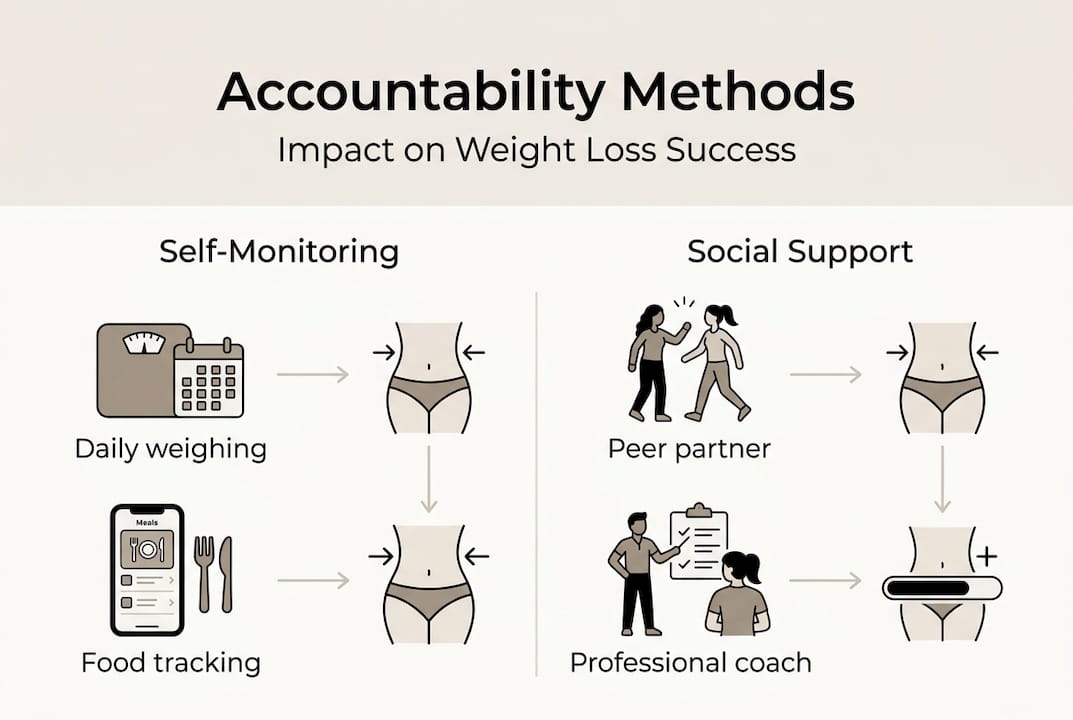
The NWCR data also shows a dose-response relationship: a consistent 100-calorie daily reduction links to roughly 0.2 kg of weight loss over time. Small actions, done consistently, add up.
75% of successful long-term maintainers weigh themselves daily or weekly. That’s not obsession. That’s information.
Building habits for weight management around regular check-ins is one of the most evidence-backed moves you can make. And if you’re just starting out, these habits for weight loss beginners are a great place to anchor your accountability practice. The way you talk to yourself during this process also matters more than most people realize. The role of self-talk in weight loss is deeply connected to how well accountability structures actually stick.
Accountability for emotional eaters: Social support, CBT, and triggers
If you eat when you’re stressed, bored, lonely, or overwhelmed, accountability hits differently for you. And I mean that in the best way.

Emotional eating isn’t a character flaw. It’s a coping pattern. The problem is that most diets treat it like a math problem. Eat less, move more. But the brain goes: “Cool story.” And then you’re elbow-deep in a bag of chips at 10 PM because your boss sent a passive-aggressive email.
Accountability structures help you catch the trigger before the behavior spirals. Here’s how different support types compare for emotional eaters:
| Support type | Strengths | Limitations |
|---|---|---|
| Peer accountability partner | Emotional connection, easy access | Limited clinical insight |
| Professional coach or therapist | Addresses root causes, personalized | Requires investment |
| CBT group support | Shared experience, structured tools | Less individualized |
| Family/social network | High engagement, daily presence | May enable old patterns |
Family social support mediated 62% of intervention attendance and linked directly to increases in healthy eating behaviors. That’s a massive influence. The people around you shape your habits more than any app ever will.
For emotional eaters specifically, combining accountability with CBT targets the irrational beliefs and emotion regulation patterns that drive overeating. It’s not just about tracking calories. It’s about understanding why you reached for food in the first place.
Common emotional triggers that accountability helps you manage:
- Stress eating after work or difficult conversations
- Boredom eating in the evenings
- Celebratory overeating (“I deserve this”)
- Shame spirals after a slip that lead to more eating
- Social pressure eating at gatherings
Pro Tip: When choosing an accountability partner for emotional eating, look for someone who is non-judgmental and consistent, not just enthusiastic. Enthusiasm fades. Reliability is what keeps you grounded on hard days. Explore these mindset shifts for emotional eaters to pair with your support structure.
Practical accountability methods: What works best?
Not all accountability tools are created equal. Here’s a ranked breakdown based on evidence and real-world sustainability.
-
Professional coaching or therapy. The gold standard. A trained coach addresses both behavior and mindset, catches blind spots, and adjusts the approach as you evolve. Professional support consistently outperforms peer-only accountability for long-term results.
-
CBT-based group programs. Structured, evidence-based, and community-driven. Great for emotional eaters who benefit from shared experience and guided tools.
-
Digital tracking apps. Useful for building self-awareness fast. The catch? Digital engagement often drops below 75% over time, and weight regain is common without sustained support beyond the app.
-
Peer accountability partners. Motivating and accessible. Best used alongside professional support rather than as a standalone strategy.
-
Self-monitoring journals. Low-tech, high-impact. Writing things down creates a different kind of reflection than tapping a screen.
The right mix depends on your emotional profile. If you’re a high-stress emotional eater, professional support plus a peer partner is a powerful combo. If you’re more of a habit-builder who just needs structure, a tracking app plus weekly self-weigh-ins might be enough to start.
Pro Tip: To avoid app drop-off, tie your tracking habit to something you already do every day, like your morning coffee or brushing your teeth. Habit stacking makes new behaviors stick. Check out this step by step weight loss guide for a practical framework, and these maintain weight loss strategies for the long game.
Limitations, challenges, and sustainable change: What most guides miss
Here’s the part most accountability articles skip. Accountability alone is not enough.
I know. That feels like a plot twist after everything we’ve covered. But it’s important.
Self-monitoring without action is just data collection. Peer support without clinical depth can feel good but miss the real issue. And if you’re an emotional eater, tracking your food without addressing why you eat emotionally is like putting a bandage on a broken arm.
“Accountability is a powerful tool, but it needs to be paired with mindset work and real behavioral change to create lasting results. Without that pairing, most people plateau or relapse.”
Common pitfalls that derail even the most motivated people:
- Stopping app use after the initial excitement fades
- Choosing an accountability partner who avoids hard conversations
- Tracking food but ignoring emotional triggers
- Having no plan for setbacks, so one bad week becomes a full relapse
- Relying on external accountability without building internal motivation
Self-monitoring alone is insufficient without action and mindset shifts. The research is clear: CBT-based approaches that target thinking patterns are essential for emotional eaters who want lasting change.
Long-term maintenance requires ongoing accountability well beyond the initial weight loss phase. The people who keep the weight off aren’t the ones who white-knuckled a diet for three months. They’re the ones who built systems, got support, and kept showing up even after a rough week.
If you’ve experienced overcoming weight loss relapse, you already know how quickly things can unravel without a plan. And building habits for long-term success is what separates a temporary result from a permanent one.
Ready to make accountability work for you?
You’ve seen the research. You know accountability is the real driver of lasting weight loss, especially when emotional eating is part of your story. But knowing and doing are two very different things.

That’s where personalized coaching changes everything. At Mindset Over Menu, we combine evidence-based accountability structures with deep mindset coaching to help you build the habits that actually stick. No rigid meal plans. No shame spirals. Just real, practical support tailored to how you think, feel, and live. Whether you’re looking for maintaining weight loss strategies or need a clear step by step weight loss plan to get started, we’ve got you covered. Your next step is one conversation away.
Frequently asked questions
Why does accountability boost weight loss more than willpower alone?
Accountability creates external structure and consistent feedback loops that keep behavior on track even when internal motivation dips. Self-monitoring is strongly linked to weight loss success precisely because it removes reliance on willpower as the only driver.
Are digital tracking apps or professional coaching better for long-term results?
Professional coaching leads to stronger long-term outcomes, especially for emotional eating patterns, because it addresses root causes rather than just behavior. Professional support outperforms peer or app-only approaches when sustained results are the goal.
How does accountability help with emotional eating triggers?
Accountability through CBT groups or support networks helps you recognize patterns before they escalate into a full emotional eating episode. CBT groups maintained BMI reductions at six months, showing that structured support makes behavior change more durable.
Is self-monitoring enough to maintain weight loss long term?
No. Self-monitoring is a powerful starting point, but it needs to be paired with mindset work and ongoing support to prevent relapse. Self-monitoring alone without addressing the thinking behind behavior rarely produces lasting change.
What’s the biggest challenge with accountability tools?
The biggest challenge is staying engaged over time. Digital engagement often drops below 75%, and without a structured ongoing plan, weight regain becomes likely once the novelty wears off.
Recommended
- How to maintain weight loss: mindset strategies 2026
- Step by step weight loss guide for lasting change 2026
- Real-life weight loss guide: 5-10% success in 2026
- Sustainable weight loss: Habits, mindset, and long-term success